
Last Updated: 06 May 2026: If you plan to vote in the 2026 Indiana primary election, understanding the rules early can save you from registration problems, ballot confusion, or missed deadlines.
Primary elections decide which candidates move forward to the November election — and in many races, the primary is where the most important decisions actually happen.
But voter eligibility rules are not the same in every state. Indiana follows its own primary system, ID requirements, and absentee voting rules.
This guide explains exactly:
- Who Can Vote in Primary Elections in the USA in 2026
- whether independents can participate,
- How party ballot selection works,
- and what steps you should take before the 2026 election deadlines.
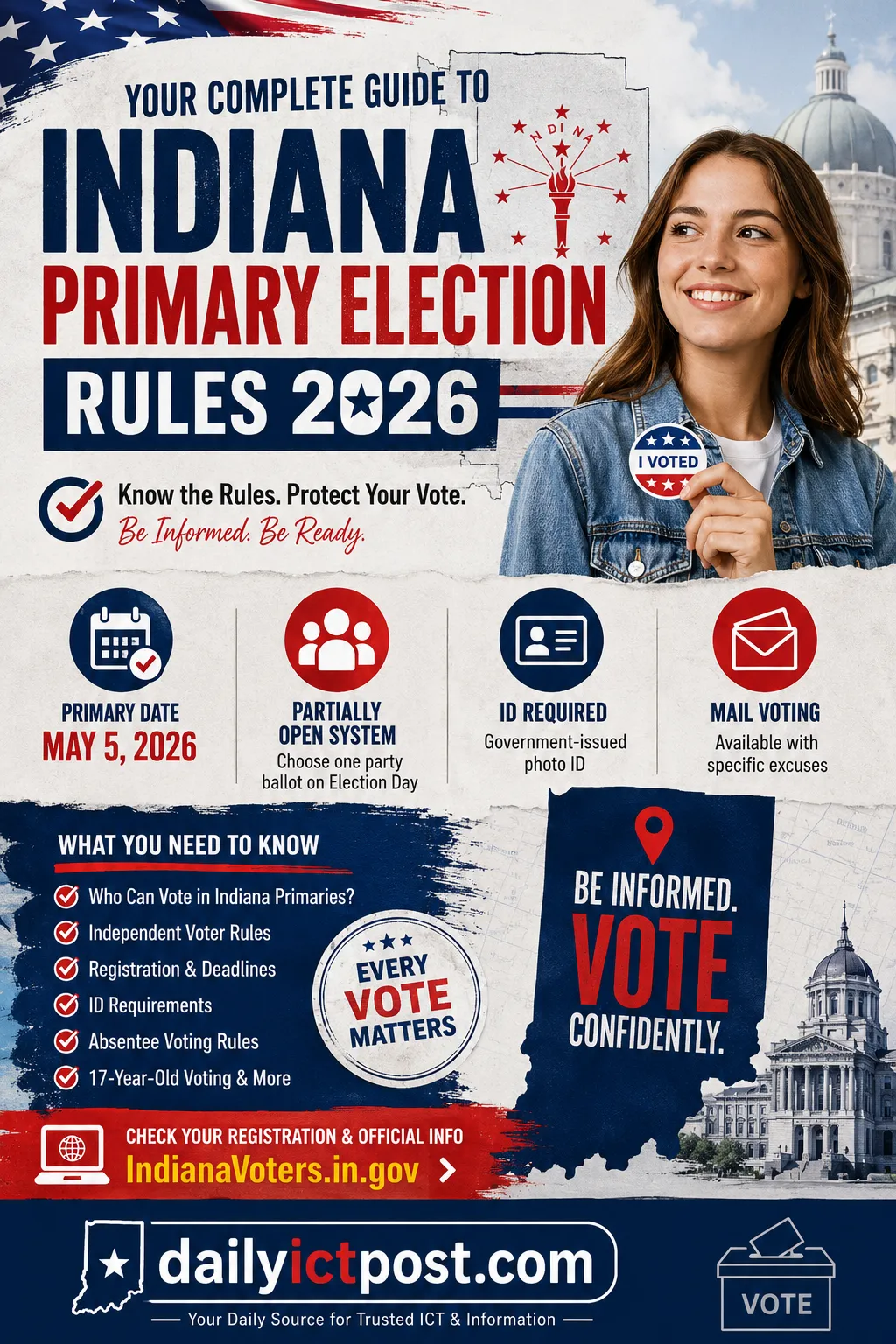
Quick Indiana Primary Snapshot:
| Topic | Indiana 2026 |
|---|---|
| Primary Date | May 5, 2026 |
| Party System | Partially Open |
| ID Required | Yes |
| Mail Voting | Available |
| Official Portal | IndianaVoters.in.gov |

Indiana Primary Election Rules 2026
Indiana uses a partially open primary system. Voters do not officially register by party, but when you vote in a primary, you choose which party ballot you want to participate in.
- Indiana primary date: May 5, 2026.
- Indiana closed/open system: Indiana uses a semi-open (partially closed) primary — voters do not register by party, but they must choose one party’s ballot and can only vote in that party’s primary.
- Indiana voter registration deadline: April 6, 2026 (29 days before the primary).
- Indiana ID requirements: Government-issued photo ID (Indiana driver’s license, state ID, passport, military ID, etc.) showing photo, name matching registration, and expiration date (can be expired after Nov 2024 general).
- Indiana absentee voting rules: Limited to specific excuses (absent from county, 65+, disability, illness, election duties, work, etc.); request by April 23, 2026; ballot must arrive by 6 PM on Election Day.
- Indiana independent voter limitations: Independents (unaffiliated) can vote in one major party’s primary by choosing the ballot on Election Day, but cannot vote in both.
Important: Indiana voters do not officially register by political party. However, voters must select one party ballot during the primary election.
Read more: How Primary Election Works in Indiana 2026 | A Complete Voter Guide for Indiana
Who Can Vote in Primary Elections in the USA: Basic Eligibility Requirements
To vote in any primary election, you must first meet these core requirements (which apply nationwide with state-level nuances):
- Be a U.S. citizen (natural-born or naturalized)
- Be at least 18 years old on or before the general election date in most cases (more on 17-year-olds below)
- Be a legal resident of the state and county where you are registering
- Not currently serving a felony sentence that disqualifies you under state law
- Be properly registered to vote by your state’s deadline
Important Nuance: Unlike general elections, primary participation often depends on your party affiliation (or lack thereof). Registration deadlines typically fall 15 to 30 days before the primary, but some states have earlier cutoffs for party changes.
Pro Tip for 2026: Many states hold primaries between March and September 2026. Check your exact date early — for example, Texas and Arkansas on March 3, California on June 2, and later states like Alaska in August.
Learn more: Indiana Primary Election Process 2026: Complete Voting Guide (Avoid Mistakes)
Understanding the Different Types of Primary Systems
The biggest factor determining who can vote in a primary election USA is the type of primary your state uses. There is no single national rule — this is why the system feels fragmented.
| Primary Type | Description | Who Can Participate | Example States (2026) | Implications |
|---|---|---|---|---|
| Closed Primary | Only registered members of that party | Party members only | Florida, New York, Pennsylvania, Kentucky | Strong party control; independents locked out |
| Open Primary | Any registered voter can choose any party’s ballot | All voters | Alabama, Michigan, Wisconsin, Texas (semi) | Higher participation, possible crossover voting |
| Semi-Closed / Partially Closed | Party members + unaffiliated/independents | Party + Independents (sometimes) | Arizona, Colorado, Connecticut | Balance between openness and party integrity |
| Top-Two Primary | All candidates on one ballot; top two advance regardless of party | Every registered voter | California, Washington | More moderate candidates possible; same-party general elections |
| Top-Four (limited) | The top four advance to the general (with possible ranked choice) | All voters | Alaska (certain races) | Greater voter choice in the general election |
As of 2026, roughly 14 states use open systems, 13 closed, and others fall into hybrid or top-two models. Some states even let parties decide their own rules.
Real-World Impact: In closed primary states like New York or Florida, if you are registered as an Independent, you cannot influence major party nominees. In California’s top-two system, you can vote for any candidate, and it’s common for two Democrats or two Republicans to face off in November.
Can Independents and Unaffiliated Voters Participate?
This is one of the most common questions.
- Closed states: Generally, no, unless you switch party registration before the deadline.
- Open & Top-Two states: Yes — independents often have full access.
- Semi-closed: Usually yes for unaffiliated voters.
Independent voters in some closed-primary states may be unable to participate in major party primaries unless they change party affiliation before the deadline.
Can Independents Vote in Indiana Primaries?
Indiana does not require voters to officially register with a political party. However, during the primary election, voters must choose one party’s ballot.
Independent voters in Indiana can still participate in primary elections, but they cannot vote across multiple party ballots during the same election.
Because rules may vary slightly by county procedures or future legislation, voters should confirm details through the Indiana voter portal before election day.
Special Voting Situations in 2026
Voting Rights for 17-Year-Olds
Around 21-22 states plus D.C. allow 17-year-olds to vote in primaries if they will turn 18 by the general election (November 3, 2026). This “future voter” rule helps engage young people early. Examples include Ohio, Virginia, and several others. Always confirm with your state election office, as some restrict them from certain races.
Felony Convictions and Voting Eligibility
This remains one of the most complex and consequential areas:
- Maine, Vermont, D.C.: Felons can vote even while incarcerated.
- Automatic restoration upon release: 23+ states (e.g., California, New York, Illinois).
- After parole/probation: Many Southern and Midwestern states.
- Permanent or difficult restoration: A few states have stricter rules for certain crimes (“moral turpitude”).
If you have a past conviction, research your exact status. Many states have simplified online restoration processes now. Millions of Americans have regained rights in recent years through reforms.
Other Edge Cases:
- Military and Overseas Voting: Uniformed and Overseas Citizens Absentee Voting Act (UOCAVA) allows early absentee voting in primaries.
- College Student Voting Rules: You can register at school or your home address, but not both.
- Homeless Voters: Most states allow affidavit-based registration using a shelter or general delivery address.
- Disability: All states must provide accessible options; many offer curbside voting.
Many first-time voters become confused because primary election rules vary dramatically between states. Someone moving from an open-primary state like Michigan to Indiana may assume the process works the same way — but ballot selection rules can differ significantly.
Step-by-Step: How to Confirm You Can Vote in 2026 Primaries
- Check Registration — Use Vote.gov or your state’s Secretary of State site.
- Verify Party Affiliation — Critical for closed primaries.
- Find Your Primary Date — Ranges from March 3 (Texas, Arkansas) to August (Alaska).
- Request Absentee/Mail Ballot if needed (deadlines vary).
- Prepare ID — Many states require photo ID; know your state’s rules.
Best Tools:
- Vote411.org
- CanIVote.org
- Your county election office
- Rock the Vote or state-specific voter guides
Why Primaries Matter More Than You Think (Strategic Context)
Primary turnout is often under 20-30%, sometimes even lower. Because primary turnout is usually lower than in general elections, smaller groups of voters can have a larger impact on the final candidates. Understanding rules helps you decide whether to participate, switch parties strategically, or advocate for reform (many states see ongoing debates about open vs closed systems).
In the 2026 midterms, with a sitting president, primaries will shape the opposition and the governing party’s direction on key issues like the economy, immigration, healthcare, and more.
How to Check Your Indiana Voter Registration Status
Indiana voters can verify:
- registration status
- polling location
- absentee ballot status
- voter information
through the official Indiana voter portal.
The Official U.S. Government Election Resources
These official U.S. government election resources help voters access trusted and accurate voting information online. From voter registration and absentee ballot support to polling location tools and federal election guidance, these websites reduce misinformation and make the voting process easier for everyone. Using authoritative federal links also improves transparency, credibility, and public trust during election seasons in the United States.
| Anchor Text | Authority Link |
|---|---|
| Vote.gov voter registration | Vote.gov voter registration |
| Federal Voting Assistance Program | Federal Voting Assistance Program |
| Election Assistance Commission | Election Assistance Commission |
| Can I Vote official tool | Can I Vote official tool |
Common Mistakes to Avoid
- Missing party switch deadlines
- Assuming national rules apply (they don’t)
- Forgetting to update the address after moving
- Not requesting an absentee ballot early
- Showing up without the required ID
Indiana vs Other Primary Systems
| State | System |
|---|---|
| Indiana | Partially Open |
| Florida | Closed |
| California | Top-Two |
| Wisconsin | Open |
Voting Accessibility Assistance in Indiana
Indiana counties provide accessible voting equipment and assistance options for voters with disabilities. Contact your county election office before Election Day for available accommodations.
Frequently Asked Questions (FAQs)
Can I vote in both parties’ primaries?
No — almost never. You usually pick one ballot.
Do primaries use the same voting machines/methods as general elections?
Usually, yes, but some states test new systems in primaries.
What if I recently moved or changed my name?
Re-register promptly. Name/address changes must be updated.
Are there any changes for 2026?
Minor updates in some states (e.g., Louisiana’s semi-closed for certain races). Always verify the latest info.
Who Can Vote in Indiana Primary Elections?
U.S. citizens who are 18 by the general election, Indiana residents for at least 30 days, registered to vote, and not currently incarcerated for a felony.
Does Indiana Have Open or Closed Primaries?
Indiana has a semi-open (partially open) primary system. Voters do not register by party, but must choose one party’s ballot on Election Day (you cannot vote in both).
What ID Do You Need to Vote in Indiana?
A government-issued photo ID (Indiana driver’s license, Indiana ID card, U.S. passport, or military ID) that shows your name and photo, and is current or expired after November 5, 2024. College/school IDs are not accepted.
Final Takeaway:
Primary elections often shape the candidates voters will ultimately see in November — especially in lower-turnout races where every vote carries more influence.
For Indiana voters in 2026, understanding registration deadlines, party ballot rules, and ID requirements early can help avoid last-minute problems at the polls.
Before election day:
– confirm your registration,
– review Indiana’s latest voting rules,
– and verify deadlines directly through official government election resources.
An informed voter is far less likely to face delays, ballot issues, or disqualification during primary season.
How This Guide Was Researched
This article was created using publicly available information from Vote.gov, state election offices, the National Association of Secretaries of State, and current 2026 election administration updates available at the time of publication.
Information Verification
Indiana election dates, absentee deadlines, and voter ID rules were verified using official Indiana state election resources available as of May 2026.
Editorial Disclaimer
This article is for informational and educational purposes only. Election laws, voter eligibility rules, registration deadlines, and absentee voting procedures may change before the 2026 elections. Readers should always verify official information through their state election office or trusted government sources such as Vote.gov and the Indiana Election Division.
Election laws and procedures may change before the 2026 primary elections due to court rulings, legislative updates, or emergency election guidance.
This article is informational only and should not be considered legal advice or an official government publication.