
Last Reviewed: 15 July 2026
Reviewed against USDA SNAP Policy
Updated for 2026 eligibility guidance
Reviewed using official state SNAP resources
If you’re applying for SNAP (Supplemental Nutrition Assistance Program), you’ve probably wondered whether the government can see what’s in your bank account.
Can SNAP See Your Bank Account in 2026? The answer isn’t as simple as yes or no. In most cases, SNAP does not monitor your bank account or track your day-to-day spending. However, your state SNAP agency may ask for bank statements or other financial records when it needs to verify information during your application or renewal.
Knowing what SNAP actually checks—and why—can help you avoid delays, submit the right documents, and feel more confident throughout the application process.
Quick Answer: Can SNAP See Your Bank Account in 2026?
No.
SNAP does not continuously monitor your bank account.
However, your state agency may request bank statements or verify financial information during your application, renewal, or fraud investigation when required by law.
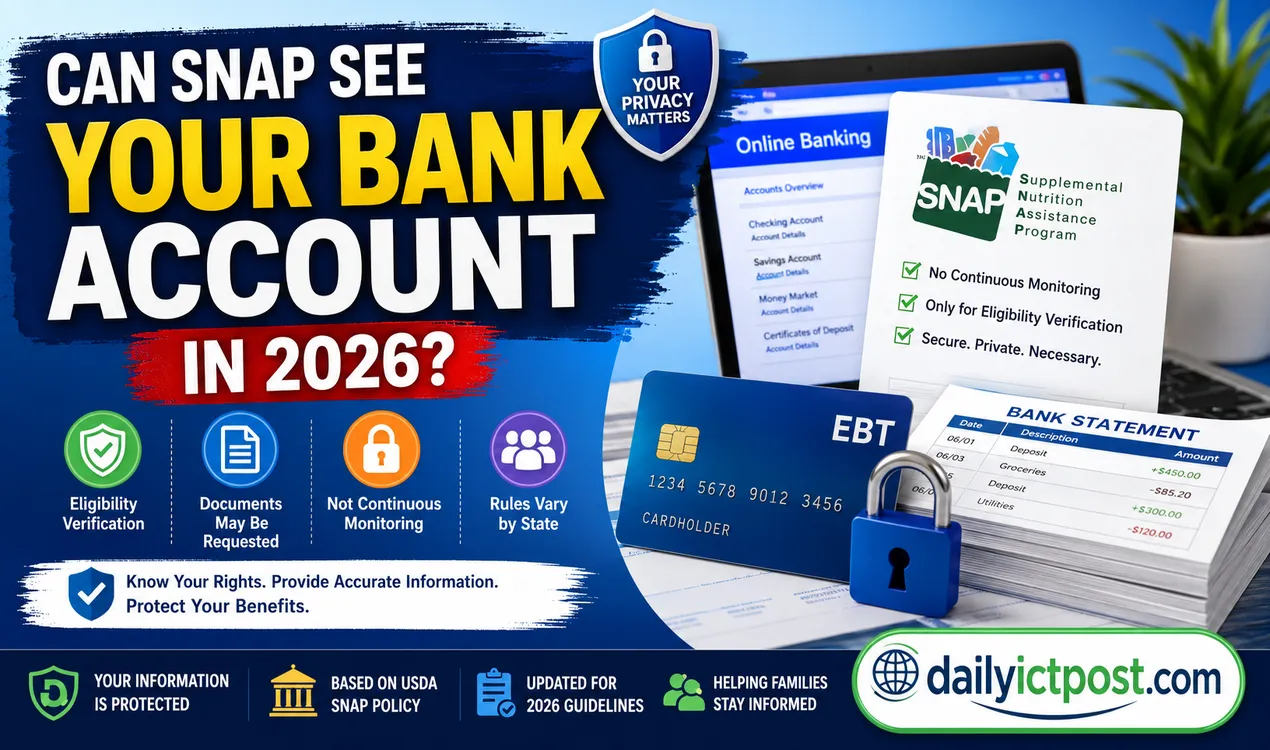
At a Glance
SNAP does NOT continuously monitor your bank account.
Your state may request bank statements during:
- Initial application
- Recertification
- Fraud investigations
- Income verification
In many states, savings alone do not disqualify you because of BBCE.
Financial records are reviewed only when legally necessary.
Can SNAP Log Into Your Bank Account?
No.
State agencies cannot log into your checking account whenever they want.
Instead, they verify financial information only through legally authorized methods during eligibility reviews.
Medicaid Income Limits 2026: [State-by-State Guide] Medicaid Income Limits Updated 2026 USA | New Rules That Could Save You Thousands
How SNAP Reviews Financial Information
SNAP is funded by the federal government but administered by individual states. While every state follows federal guidelines, each has some flexibility in how it verifies eligibility.
When you apply, the agency’s main goal is to confirm that the information on your application is accurate. Depending on your situation, you may be asked to verify your income, identity, household size, residency, and in some cases, your financial resources.
For most households today, income is much more important than the amount of money in a bank account. That’s because many states use Broad-Based Categorical Eligibility (BBCE), which allows them to remove or raise the federal asset limit for many applicants.
As a result, simply having a checking or savings account usually does not prevent someone from qualifying for SNAP.
Read more: {Nervous?} Why Was My SNAP Case Closed in 2026? Absolute Common Reasons
When SNAP May Ask About Your Bank Account
SNAP agencies don’t routinely request bank records from everyone. They typically do so only when they’re needed to determine eligibility or verify information.
During Your Initial Application
When you first apply, your state may ask for bank statements if financial resources are part of the eligibility review or if additional verification is needed.
Depending on your circumstances, you may be asked to provide:
- Recent checking account statements
- Savings account balances
- Credit union account information
- Money market account records
These documents help confirm that the information on your application is complete and accurate.
During Recertification
SNAP benefits aren’t permanent. Every household must complete a renewal or recertification after a certain period.
If your financial situation has changed since your last certification, your caseworker may request updated bank records before approving another benefit period. This is a normal part of the review process and doesn’t necessarily mean there’s a problem with your case.
When Information Doesn’t Match
Many state agencies use electronic verification systems to compare the information you report with data from other approved sources.
If something doesn’t match—for example, your reported income appears inconsistent with other records—the agency may ask for additional documentation, including bank statements, before making a final eligibility decision.
Providing the requested documents promptly usually helps resolve these issues more quickly.
Find out more: [WORRIED?] SNAP Pending Status Meaning 2026: Why Benefits Are Delayed
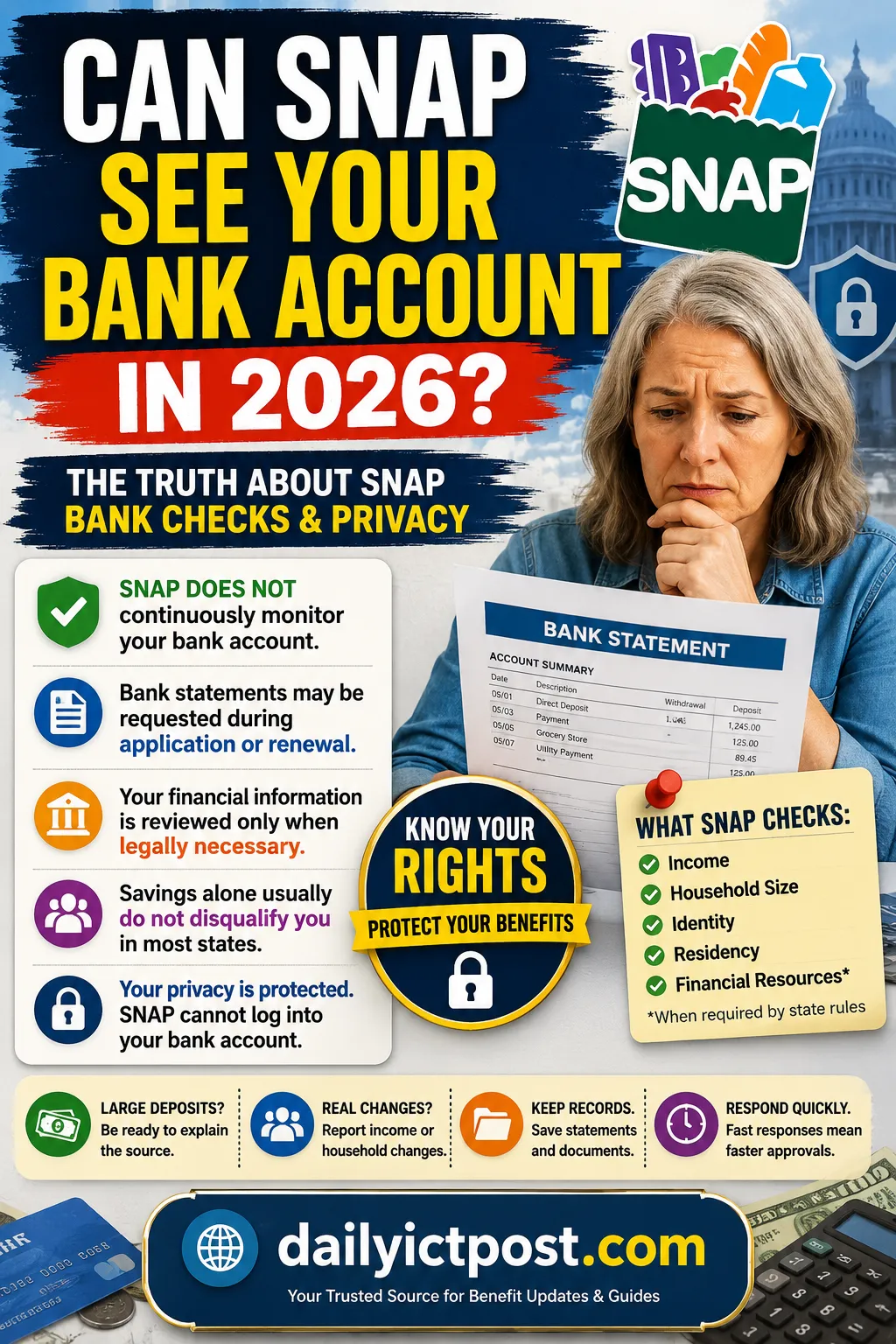
Does SNAP Monitor Your Bank Account Continuously?
No. SNAP does not continuously monitor your bank account or review your transactions every month.
Instead, financial information is generally reviewed only during specific stages of the eligibility process or when additional verification is required.
| Situation | Could Bank Information Be Requested? |
|---|---|
| Initial SNAP application | Sometimes |
| Benefit renewal or recertification | Sometimes |
| Reported changes in household circumstances | Possibly |
| Fraud investigation | Often |
| Routine monthly monitoring | No |
The agency’s purpose is to verify eligibility—not to watch how you spend your money after you’re approved.
Continue Reading: [Major Update] EBT Benefits Arrival Dates 2026: When Your SNAP Payment Will Arrive
What Bank Information Can SNAP Request?
When bank records are needed, the agency generally requests only the information necessary to determine eligibility.
Common examples include:
| Information Requested | Why It May Be Needed |
|---|---|
| Current account balance | To verify available resources when applicable |
| Recent deposits | To confirm the reported income |
| Account ownership | To identify who owns the funds |
| Large or unusual deposits | To clarify the source of the money |
| Savings account balances | To verify countable assets if state rules require it |
The review focuses on eligibility, not personal spending habits. In most cases, the agency is looking for documentation that supports the information you’ve already reported.
See more: State by State EBT Schedule July 2026: Best SNAP Payment Dates for All States
Does SNAP Count Money in Your Bank Account?
It depends on your state’s rules and your household’s eligibility category.
Many states no longer apply a traditional asset test to most SNAP applicants because they use Broad-Based Categorical Eligibility. In those states, having money in a checking or savings account often has little or no impact on eligibility.
However, some households may still face resource constraints, so financial assets can matter in certain situations.
Resources that may be considered include:
- Checking accounts
- Savings accounts
- Certificates of deposit (CDs)
- Cash on hand
- Certain investment accounts
On the other hand, several assets are commonly excluded under federal or state SNAP rules, including:
- Your primary home
- Most retirement accounts
- Household furniture and personal belongings
- One or more vehicles, depending on your state’s policy
Because eligibility rules can vary, it’s always a good idea to review your state’s SNAP requirements if you’re unsure whether your financial resources will affect your application.
Does SNAP Have Direct Access to Your Bank Account?
In most cases, no. SNAP agencies do not have unrestricted access to your personal bank account or the ability to monitor it whenever they choose.
Instead, they verify financial information through approved methods during the application or renewal process. That may include reviewing the documents you provide, using authorized verification systems, or requesting additional records if anything needs clarification.
When you sign a SNAP application, you also authorize the agency to verify information that’s relevant to determining your eligibility. That doesn’t mean the agency can freely monitor your account or view your everyday transactions.
Common Situations That Raise Questions
Some financial situations naturally lead to more questions during the eligibility process. Here are a few common examples.
You Received a Large Deposit
A large deposit doesn’t automatically mean you’ll lose your SNAP benefits. What matters is where the money came from.
Your caseworker may ask whether the deposit was:
- Income from a job
- A gift from family or friends
- A tax refund
- The sale of property
- Another one-time payment
Keeping documentation that explains the source of the deposit can help avoid delays.
You Share a Joint Bank Account
Having a joint account doesn’t automatically mean all of the money belongs to you.
If necessary, your caseworker may ask who owns the funds or how the money is used. Clear records can help determine which funds should be considered when reviewing your case.
You recently sold a property
If you recently sold a vehicle, land, or another valuable asset, the agency may ask for additional information about the sale.
Whether the proceeds affect your eligibility depends on your state’s rules and your individual circumstances. Reporting the change promptly and providing supporting documents is usually the best approach.
What You Must Report Honestly
When applying for SNAP, accuracy is essential. Providing complete and truthful information helps prevent delays and future problems with your benefits.
Depending on your situation, you may need to report:
- Employment income
- Self-employment earnings
- Social Security benefits
- Unemployment benefits
- Financial resources when required by your state
- Changes in household size or address
If the required information isn’t reported, it could lead to:
- Benefit overpayments
- A request to repay benefits
- Temporary loss of benefits
- Penalties if intentional fraud is found
If you’re unsure whether a change must be reported, it’s better to contact your local SNAP office than to make assumptions.
Comparison
| Situation | SNAP May Check? | Reason |
|---|---|---|
| Apply | Yes | Verify eligibility |
| Renewal | Sometimes | Update records |
| Monthly | No | No routine monitoring |
| Fraud Investigation | Yes | Required by law |
Common Misunderstandings
| Myth | Reality |
|---|---|
| SNAP watches every bank transaction. | No. Financial information is reviewed only when necessary to determine or verify eligibility. |
| Having savings automatically disqualifies you. | No. Many states no longer apply an asset limit to most households. |
| SNAP can access your bank account whenever it wants. | No. Verification follows legal procedures and is limited to eligibility purposes. |
| One large deposit always causes benefits to stop. | No. The source and type of the deposit are what matter. |
Many applicants become worried after seeing requests for bank statements. In practice, this usually happens because the caseworker needs additional verification—not because the application has been denied.
Learn more: Federal SNAP Eligibility Regulations
Expert Tips
A few simple habits can make the SNAP application or renewal process much easier.
- Keep recent bank statements in a safe place.
- Save records explaining large deposits or one-time payments.
- Report required changes as soon as possible.
- Respond quickly if your caseworker requests additional documents.
- Review your state’s SNAP eligibility rules before applying or renewing benefits.
Being organized can help your application move through the review process more smoothly.
Common Mistakes to Avoid
Many application delays stem from small, preventable mistakes.
Avoid these common issues:
- Forgetting to report new income
- Estimating account balances instead of using actual records
- Ignoring requests for verification
- Assuming every state follows the same SNAP rules
- Waiting too long to report required household changes
Taking a few extra minutes to review your application can help prevent unnecessary delays.
Quick Facts
| Question | Answer |
|---|---|
| Can SNAP see your bank account? | It may review bank information during eligibility verification. |
| Does SNAP monitor bank accounts every month? | No. |
| Can SNAP request bank statements? | Yes, if they’re needed to verify your application or renewal. |
| Will savings automatically disqualify you? | Not in most states, but eligibility rules vary. |
| Should you keep records of large deposits? | Yes. Documentation can help explain one-time transactions if questions arise. |
Key Takeaways
- SNAP does not monitor your bank account every month.
- State agencies may verify financial records during eligibility reviews.
- Most households are more affected by income than by savings.
- Responding quickly to verification requests helps prevent delays.
Frequently Asked Questions
Can SNAP check my savings account?
Yes. If your state requires verification of financial resources, it may ask you to provide recent savings account statements.
Will SNAP know if I open a new bank account?
Not automatically. However, if you’re required to report financial information during an application or renewal, you should provide accurate and complete information.
Can I be denied SNAP because I have money in the bank?
Possibly, but it depends on your state’s eligibility rules. Many states no longer use an asset test for most households, while others still consider certain financial resources.
Does SNAP verify bank deposits?
Sometimes. If deposits affect your eligibility or don’t match the information on your application, your caseworker may ask for an explanation or supporting documents.
Does SNAP look at my spending history?
Generally, no. SNAP agencies are concerned with verifying eligibility, not reviewing how you spend your money.
Are retirement accounts counted for SNAP?
Many retirement accounts are excluded under SNAP rules, though the exact treatment can vary by federal and state policies.
Final Thoughts
For most applicants, the answer to “Can SNAP see your bank account?” is only when it’s necessary to verify your eligibility.
SNAP agencies don’t routinely monitor your account or track your everyday spending. They may request bank statements or other financial records during an application, renewal, or when additional verification is needed.
The best way to avoid delays is to provide accurate information, respond promptly to document requests, and keep records of any significant financial changes. If you’re unsure how your state’s rules apply to your situation, check with your local SNAP office or your state’s official SNAP website before submitting your application.
Editorial Note
This article is based on publicly available USDA SNAP policy guidance, federal regulations, and official state SNAP eligibility resources available as of 2026. It is intended for educational purposes only and should not be considered legal or financial advice. Because SNAP eligibility rules can vary by state, applicants should always verify requirements with their local SNAP agency.
Sources Used
This guide was prepared using:
- USDA Food and Nutrition Service
- 7 CFR Part 273
- State SNAP policy manuals
- Official state SNAP eligibility portals


![[Anxious] EBT Card Not Working Today - Best Way to Fix It (2026 Guide)](https://dailyictpost.com/wp-content/uploads/2026/07/Anxious-EBT-Card-Not-Working-Today-Best-Way-to-Fix-It-2026-Guide-150x150.webp "[Anxious?] EBT Card Not Working Today? Best Way to Fix It (2026 Guide)")