Last Updated: April 2026 (Based on official state election data): The 2026 midterm elections are set for November 3, 2026, and the primary season is already here. Primary elections determine which candidates will appear on the general election ballot for Congress, governor, and state legislatures. Whether you’re a first‑time voter or a seasoned participant, knowing your state’s primary schedule, rules, and deadlines is key to making your voice heard.
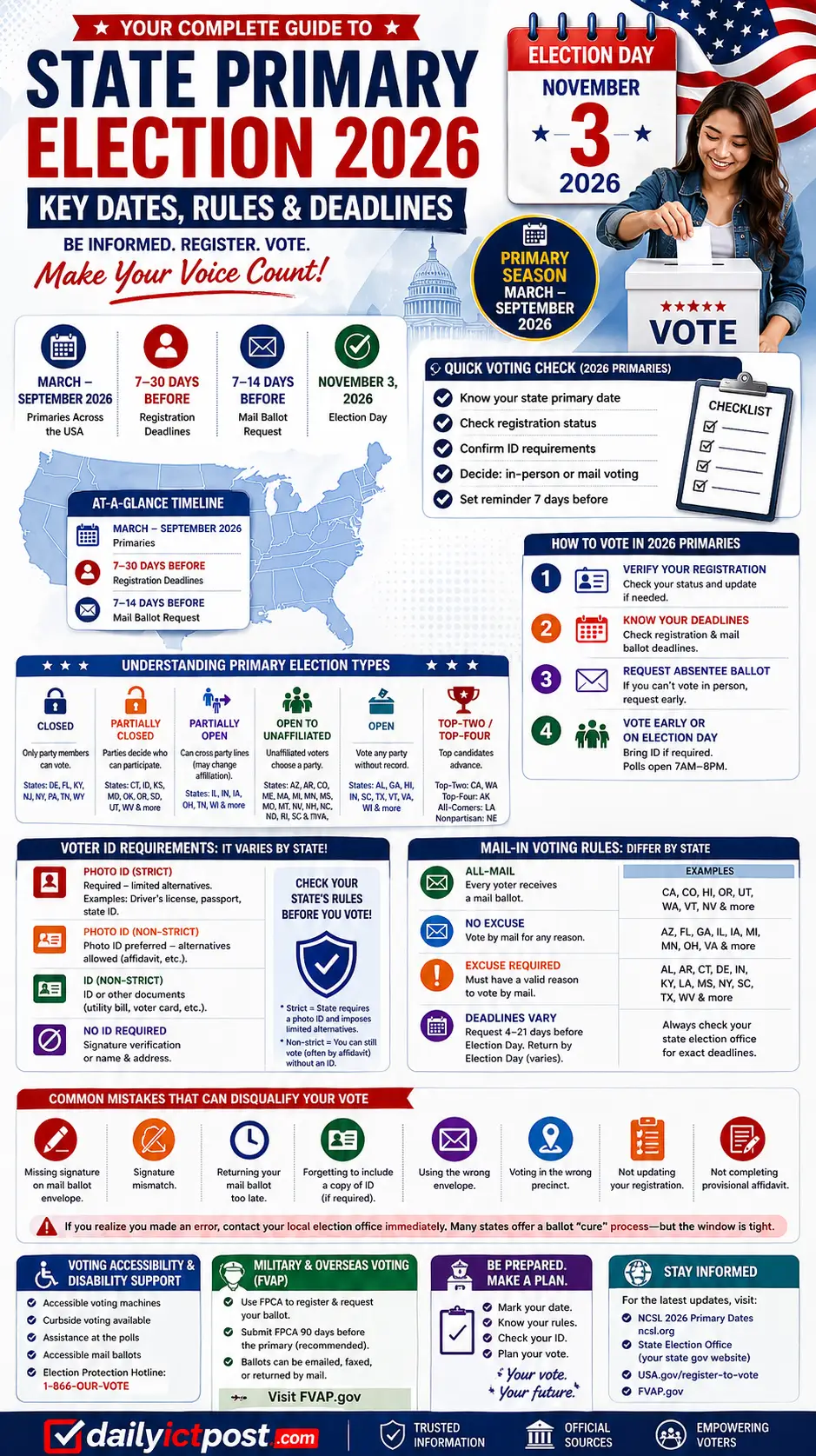
Quick Overview: The State Primary Election 2026
Election Date: November 3, 2026
Primary Season: March – September 2026
Busiest Month: June (15+ primaries)
Registration Deadline: 7–30 days before primary
Mail Ballot Request: 7–14 days before election
Always verify your state rules before voting.
Quick Voting Check (2026 Primaries):
Know your state primary date
Check registration status
Confirm ID requirements
Decide: in-person or mail voting
Set reminder 7 days before
At-a-Glance Timeline:
March–September: Primaries
7–30 days before: Registration deadlines
7–14 days before: Mail ballot request
Who This Guide Is For?
First-time voters in the USA
People who recently moved states
Students and young voters
Anyone confused about primary election rules
If you fall into any of these groups, this guide will help you avoid mistakes.
The State Primary Election Calendar 2026- Full Calendar + Best Voting Rules ever
The State Primary Election Calendar 2026: Key Dates at a Glance
State primaries begin March 3, 2026 and continue through mid‑September. June is the busiest month, with 15 primaries. The table below lists primary dates for all 50 states. Because runoffs are required in several states when no candidate receives a majority, we’ve included both initial and runoff dates.
The State Primary Election Calendar 2026- Full Calendar
Not all primaries work the same way. Understanding your state’s system will help you prepare and avoid surprises at the polls.
Closed Primaries
Only voters who are registered with a specific party may vote in that party’s primary. Independent or unaffiliated voters are generally excluded.
States: Delaware, Florida, Kentucky, New Jersey, New York, Pennsylvania, Tennessee, Wyoming
Partially Closed Primaries
State law allows political parties to decide whether to let unaffiliated voters—or voters registered with another party—participate in their primaries. This can change from year to year.
States: Connecticut, Idaho, Kansas, Maryland, Oklahoma, Oregon, South Dakota, Utah, West Virginia
Partially Open Primaries
Voters may cross party lines to vote, but doing so may be recorded as a change in party affiliation.
A voter who is not registered with any party may choose which party’s primary to vote in. Party‑registered voters must still vote in their own party’s primary.
States: Arizona, Arkansas, Colorado, Maine, Massachusetts, Michigan, Minnesota, Mississippi, Missouri, Montana, Nevada, New Hampshire, North Carolina, North Dakota, Rhode Island, South Carolina, Vermont, Virginia, Washington, West Virginia
Open Primaries
Voters choose which party’s primary they wish to participate in—regardless of their own registration—without any public record of their choice.
All candidates appear on a single ballot, regardless of party. The top vote‑getters advance to the general election.
Top‑Two: California, Washington (top two finishers advance)
Top‑Four: Alaska (top four finishers advance)
All‑Comers: Louisiana (for congressional races, all candidates run together; if no one wins a majority, the top two proceed to a runoff)
Nonpartisan: Nebraska (state legislative races are nonpartisan, but the state holds partisan primaries for federal offices)
How to Vote in the 2026 Primaries
Step 1: Verify Your Registration
Before voting, check your voter registration status in the USA to avoid missing your state deadline. You can check your registration status online through your state’s election website. Many states now offer same‑day registration, meaning you can register and vote at the same time.
Step 2: Know Your Deadlines
Voter registration and absentee‑ballot deadlines vary by state. Here is a sample of 2026 deadlines; always confirm with your state’s election office.
Primary Date
State
Registration Deadline
May 19, 2026
Alabama
May 4 (in‑person, mail, online)
June 2, 2026
California
May 18 (mail, online); same‑day registration available at polls
June 9, 2026
Maine
June 9 (same‑day registration available at polls)
Aug. 4, 2026
Virginia
July 24 (mail, online)
Aug. 11, 2026
Connecticut
Aug. 10 (in‑person)
Deadlines for military and overseas voters differ. Visit FVAP.gov for specific forms and instructions.
Step 3: Request an Absentee Ballot (If Needed)
If you cannot vote in person, request an absentee or mail ballot early. Deadlines to request a mail ballot typically fall 7‑14 days before the primary. For example, Rhode Island’s mail‑ballot deadline is Aug. 18, 2026 for its Sept. 9 primary.
Step 4: Vote Early or on Election Day
Many states offer early in‑person voting. Check your state’s early‑voting dates and locations. On Election Day, bring an accepted form of ID if your state requires it. Poll hours vary; typically they are open 7 a.m. to 8 p.m. local time.
This is where many people get confused—every state has different ID rules. Some states require a photo ID, others accept non‑photo documents, and a few have no ID requirement at all. Use this table to check what you’ll need before heading to the polls.
State
ID Category
Acceptable Examples
Alabama
Photo ID (strict)
Driver’s license, passport, state ID, student ID from a public college
Alaska
Photo ID (non‑strict)
Photo ID or utility bill + signature ID
Arizona
Photo ID (strict)
Photo ID or two non‑photo documents with name & address
Arkansas
Photo ID (strict)
Photo ID; provisional ballot without one, must return with ID later
California
No ID required
Signature verification; first‑time voters who registered by mail may need ID
Colorado
No ID required
Signature match on mail ballot; in‑person voters may show utility bill
Connecticut
Photo ID (non‑strict)
Driver’s license, passport, credit card with photo, student ID
Delaware
Photo ID (non‑strict)
Photo ID; if none, sign an affidavit of identity
Florida
Photo ID (strict)
Photo ID; provisional ballot without one, cure by signature match
Georgia
Photo ID (strict)
Driver’s license, state ID, passport, military ID, tribal ID
Hawaii
Photo ID (non‑strict)
Photo ID; if none, sign a voter registration card and show a utility bill
Idaho
Photo ID (non‑strict)
Photo ID; without one, sign an affidavit and show ID later
Illinois
No ID required
Signature verification; ID only needed for same-day registration
Indiana
Photo ID (strict)
Photo ID issued by state or federal government
Iowa
ID (non‑strict)
Photo ID or signature verification using voter registration card
Kansas
Photo ID (strict)
Photo ID; free state ID available
Kentucky
Photo ID (non‑strict)
Photo ID; without one, sign an affirmation of identity
Louisiana
Photo ID (non‑strict)
Photo ID; without it, vote by affidavit or challenged ballot
Maine
No ID required
Signature verification; ID requested but not required
Maryland
No ID required
Voter identifies by name and address, signature check
Massachusetts
No ID required
Signature verification; first‑time voters may need ID if registered by mail
Michigan
Photo ID (non‑strict)
Photo ID; if none, sign an affidavit of identity
Minnesota
No ID required
Signature verification; ID only needed for same‑day registration
Mississippi
Photo ID (strict)
Photo ID; free voter ID available
Missouri
Photo ID (strict)
Photo ID; without one, vote provisional and return later with ID
Montana
ID (non‑strict)
Photo ID, student ID, utility bill, or provisional ballot with affidavit
Nebraska
No ID required
Signature verification; first‑time registrants may need ID
Nevada
No ID required
Signature verification on mail ballot; ID for in‑person registration
New Hampshire
Photo ID (non‑strict)
Photo ID; without it, sign an affidavit and vote
New Jersey
No ID required
Signature check; ID only if first‑time registrant who registered by mail
New Mexico
No ID required
Signature verification; ID may be requested but not mandatory
New York
No ID required
Signature verification; ID only needed for first‑time mail registrants
North Carolina
Photo ID (strict)
Photo ID; free voter ID available; reasonable impediment affidavit accepted
North Dakota
ID (strict)
ID with name, date of birth, and current address; no photo required
Ohio
Photo ID (strict)
Photo ID or a military ID; or a utility bill with voter’s address
Oklahoma
Photo ID (strict)
Photo ID; provisional ballot without one
Oregon
No ID required
All‑mail voting; signature match on envelope
Pennsylvania
Photo ID (non‑strict)
Photo ID; without it, vote provisional and provide ID later
Mail‑ballot signature verification; ID required for in‑person same‑day reg
Vermont
No ID required
Signature check; ID requested but not required
Virginia
Photo ID (strict)
Photo ID; without one, sign an affirmation of identity
Washington
No ID required
All‑mail; signature match on envelope
West Virginia
Photo ID (non‑strict)
Photo ID; without it, vote provisional and signature affidavit
Wisconsin
Photo ID (strict)
Photo ID; free state ID available
Wyoming
Photo ID (non‑strict)
Photo ID; if none, sign an affidavit
Note:Strict means the state requires a photo ID and imposes limited alternatives. Non‑strict means you can still vote (often by affidavit) even without an ID. Always check your state’s election website for the most current list of acceptable IDs.
Mail‑in Voting Rules: State Differences
All states offer some form of absentee or mail voting, but the rules differ dramatically. Some send every registered voter a mail ballot automatically, others require an excuse, and many allow voting by mail for any reason.
State
Mail Voting Policy
Ballot Request Deadline (typical)
Ballot Return Deadline
Alabama
Excuse required
5 days before Election Day
Noon on Election Day
Alaska
No excuse
10 days before Election Day
Postmarked by Election Day
Arizona
No excuse; permanent mail‑ballot list available
11 days before Election Day
Election Day by 7 PM
Arkansas
Excuse required
7 days before Election Day
Election Day by 7:30 PM
California
All‑mail (every voter gets a ballot)
7 days before Election Day (for replacement)
Postmarked by Election Day
Colorado
All‑mail
8 days before Election Day (in‑person request)
Election Day by 7 PM
Connecticut
Excuse required (2024 constitution change may expand; check for 2026)
Day before Election Day (in person)
Election Day by 8 PM
Delaware
Excuse required
4 days before Election Day
Election Day by 8 PM
Florida
No excuse
10 days before Election Day
Election Day by 7 PM
Georgia
No excuse
11 days before Election Day
Election Day by 7 PM
Hawaii
All‑mail
7 days before Election Day
Election Day by 7 PM
Idaho
No excuse
11 days before Election Day
Election Day by 8 PM
Illinois
No excuse
5 days before Election Day
Postmarked by Election Day
Indiana
Excuse required
12 days before Election Day
Election Day by noon
Iowa
No excuse
15 days before Election Day
Election Day by 8 PM
Kansas
No excuse
7 days before Election Day
Postmarked by Election Day
Kentucky
Excuse required
7 days before Election Day
Election Day by 6 PM
Louisiana
Excuse required
4 days before Election Day
Day before Election Day (mail) / Election Day (in person)
Maine
No excuse
Request by 3rd business day before Election (in person)
Election Day by 8 PM
Maryland
No excuse
7 days before Election Day
Election Day by 8 PM
Massachusetts
No excuse
5 days before Election Day
Election Day by 5 PM
Michigan
No excuse
5 PM the Friday before Election Day
Election Day by 8 PM
Minnesota
No excuse
1 day before Election Day (in person)
Election Day by 8 PM (mail), 3 PM (in person)
Mississippi
Excuse required
7 days before Election Day
Election Day by 7 PM
Missouri
Excuse required
2nd Wednesday before Election Day
Day before Election Day
Montana
No excuse; all‑mail in many counties
Noon the day before Election Day
Election Day by 8 PM
Nebraska
No excuse
11 days before Election Day
Election Day by 8 PM
Nevada
All‑mail
14 days before Election Day
Postmarked by Election Day
New Hampshire
Excuse required
Day before Election Day (in person)
Election Day by 5 PM
New Jersey
No excuse
7 days before Election Day
Election Day by 6 PM
New Mexico
No excuse
5 PM the Friday before Election Day
Election Day by 7 PM
New York
Excuse required for primary; may expand by 2026
15 days before Election Day
Postmarked by Election Day
North Carolina
No excuse
7 days before Election Day
Election Day by 7:30 PM
North Dakota
No excuse
Day before Election Day
Postmarked by day before Election Day
Ohio
No excuse
3 days before Election Day
Postmarked by day before Election Day
Oklahoma
No excuse
5 PM the Tuesday before Election Day
Election Day by 7 PM
Oregon
All‑mail
8 days before Election Day (replacement)
Election Day by 8 PM
Pennsylvania
No excuse
7 days before Election Day
Election Day by 8 PM
Rhode Island
No excuse
21 days before Election Day
Election Day by 8 PM
South Carolina
Excuse required
4 days before Election Day
Election Day by 7 PM
South Dakota
No excuse
5 PM the day before Election Day
Election Day by 7 PM
Tennessee
Excuse required
7 days before Election Day
Election Day by close of polls
Texas
Excuse required (65+, disability, out of county, etc.)
11 days before Election Day
Postmarked by Election Day
Utah
All‑mail
11 days before Election Day
Postmarked day before Election Day
Vermont
All‑mail
Day before Election Day
Election Day by 7 PM
Virginia
No excuse
11 days before Election Day
Postmarked by Election Day
Washington
All‑mail
8 days before Election Day (online)
Postmarked by Election Day
West Virginia
Excuse required
6 days before Election Day
Postmarked by Election Day
Wisconsin
No excuse
5 days before Election Day
Election Day by 8 PM
Wyoming
No excuse
Day before Election Day (in person)
Election Day by 7 PM
Reminder: Excuse categories and deadlines can change. Always confirm your eligibility and the exact timeline with your state election office.
Common Mistakes That Can Disqualify Your Vote
Each election, thousands of ballots are rejected because of small errors. Avoid these pitfalls and make sure your vote counts.
Missing signature on a mail ballot envelope. Many states require your signature on the outer return envelope; if it’s blank, your ballot is void.
Signature mismatch. If the signature on your mail ballot doesn’t match the one on file (often from your driver’s license or voter registration), it may be rejected. Some states allow you to “cure” it—contact your election office immediately.
Returning your mail ballot too late. Even if postmarked by Election Day, ballots must be received by the deadline (often 1–3 days after). Using a ballot drop box or returning it early is the safest route.
Forgetting to include a copy of ID. Some states require a photocopy of your ID with the mail ballot. Check your state’s rules.
Using the wrong envelope. Secrecy envelopes and outer envelopes must be used correctly. A ballot placed loose in the mailing envelope can be disqualified.
Voting in the wrong precinct. On Election Day, showing up at the wrong polling place may mean you cast a provisional ballot that could be partially rejected.
Not updating your registration. If you moved, your name may not appear on the rolls, or your signature may not be current. Update at least 30 days before the primary.
Failing to sign an affidavit when voting provisional. If you vote provisionally, you must complete and sign all required paperwork—otherwise the ballot won’t count.
If you realize you made an error, contact your local election office immediately. Many states offer a ballot “cure” process—but the window is tight.
Voting Accessibility & Disability Support
Federal law guarantees accessible voting for people with disabilities. Here’s what you can expect and where to find help.
Accessible voting machines. Every polling place must have at least one accessible voting system (audio ballot, touch screen with sip‑and‑puff support, etc.).
Curbside voting. Many states allow you to vote from your vehicle if you have a disability or difficulty entering the polling place. Look for a designated curbside spot or call ahead.
Assistance at the polls. You can bring a friend, family member, or a poll worker to help mark your ballot (except your employer or union rep). You are not required to disclose your disability.
Mail ballot accessibility. Some states offer accessible electronic ballots (e.g., PDF that works with screen readers) for voters who cannot use a paper ballot. Check your state’s absentee portal.
Voter hotlines. The Election Protection Hotline (1‑866‑OUR‑VOTE) offers help in multiple languages, including for disability‑related issues.
If you are a U.S. citizen living overseas or a member of the uniformed services, the Federal Voting Assistance Program (FVAP) ensures you can vote in federal elections—even during a primary.
Key Programs
Uniformed and Overseas Citizens Absentee Voting Act (UOCAVA) – covers active‑duty military, their families, and U.S. citizens residing abroad.
Federal Post Card Application (FPCA) – use this form to register to vote and request an absentee ballot. It’s accepted by all states.
Federal Write‑In Absentee Ballot (FWAB) – a backup ballot you can use if your state ballot doesn’t arrive in time.
Important Deadlines
Register and request your ballot early. The recommended FPCA submission date is 90 days before the primary (or at least 45 days before).
Return your ballot. Most states allow military/overseas ballots to be emailed, faxed, or returned by mail with special expedited timelines. Check your state’s specific rules on FVAP.gov.
Visit FVAP.gov to fill out the FPCA online, find your state’s deadlines, and get step‑by‑step instructions. The service is free, secure, and designed to make your vote count from anywhere in the world.
Pro Tip: If you are deployed or living abroad, submit a new FPCA every year and every time your mailing address changes. This ensures your ballot reaches you without delay.
Editorial Disclaimer:
This content is for informational purposes only and is based on publicly available election data as of April 2026. Election dates, rules, and procedures may change without notice.
Always verify information directly with your state election office or official government websites such as 4 before making any voting decisions.
Conclusion: Be Prepared, Make a Plan
The State Primary Election 2026 USA is your first chance to shape the ballot for the November midterms. With primaries spanning from March to September, it’s easy to miss a deadline. Use the calendar above to mark your state’s date, verify your registration, and make a plan to vote—whether in person, by mail, or during early voting.
These are the most searched questions by voters in 2026.
Frequently Asked Questions
Which states hold their primaries first in 2026?
Arkansas, North Carolina, and Texas hold the first primaries on March 3, 2026.
When is the busiest month for primaries?
June 2026—15 states hold primaries or runoffs.
Can I vote in a primary if I’m not registered with a political party?
It depends on your state. In open or open‑to‑unaffiliated states, yes. In closed primary states, you must be registered with a party. Check the “Understanding Primary Election Types” section above.
What happens if no candidate receives a majority of votes in a primary?
Several states require a runoff election between the top finishers. For example, Alabama, Arkansas, Georgia, Mississippi, North Carolina, Oklahoma, South Carolina, and Texas all have runoff provisions.
Are primary election dates subject to change?
Yes. Dates are based on statutes as of April 21, 2026, but legislatures can change them. Always confirm with your state election board before making plans.
How do I find my state’s voter registration deadline for the 2026 primary?
Visit your state’s election website or use NPR’s interactive voter‑registration guide for a comprehensive list of deadlines.
This blog post is for informational purposes only. Always check your state’s official election website for the most current rules and deadlines.
The dailyictpost.com team presents job recruitment notices, various government and private job question solutions, government post activities and technology-based information in simple and practical language. Along with this, we explain ICT, mobile, computer, apps, online income, digital tools, government services, national elections and cyber security-related issues in such a way that the reader can understand and learn.
We believe that learning technology is not difficult, if it is explained correctly. Therefore, we present complex topics like using new software, mobile settings or digital marketing step by step in such a language that it feels like someone is sitting next to you and explaining it in a simple way.
Our goal is only one - that the reader gets accurate information, learns with confidence and can use that knowledge in real life.