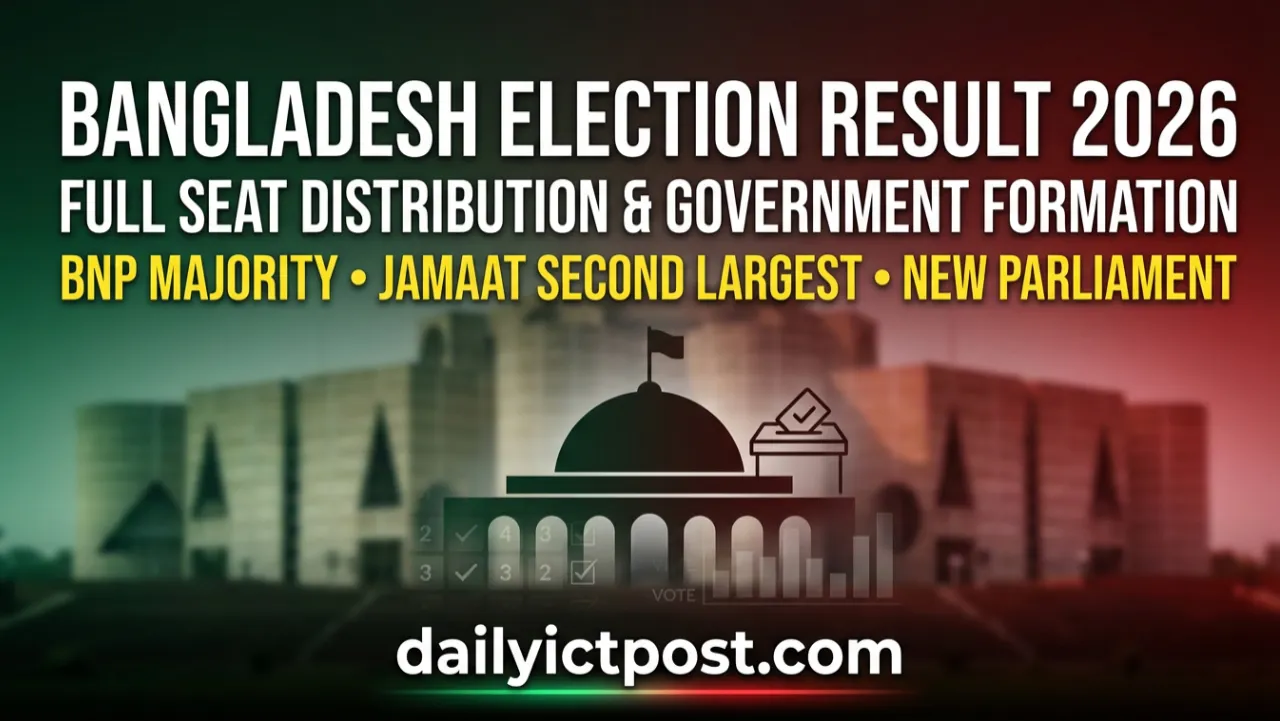
The 13th National Parliament Election of Bangladesh, held on 12 February 2026, resulted in a major shift in parliamentary representation. According to reported results, the Bangladesh Nationalist Party (BNP) secured a parliamentary majority, enabling it to form the government.
This article provides:
Full seat distribution
Party-wise performance
Regional voting trends
Key candidate victories
Political and policy implications
Bangladesh Election Result 2026 Analysis – At a Glance
Total Seats: 299
Majority Required: 150
Seat Distribution:
BNP → 209
Jamaat-e-Islami → 68
Independents → 7
Others → 0
Bangladesh Election Result 2026 Analysis – Full Seat Distribution, Winner & Analysis
Bangladesh holds parliamentary elections approximately every five years to elect Members of Parliament (MPs) to the Jatiya Sangsad (National Parliament). The country is divided into 299 constituencies, each electing one MP through first-past-the-post voting. A majority of seats (150+) is required to form the government.
There were a total of 2,028 candidates, including 273 independents.
127.7 million voters were registered, with postal ballots for expatriates included.
This election drew significant national and international attention because it followed a period of major political developments and transition in Bangladesh’s governance.
Election Process Detailed
We have seen a clear election timeline, letting readers follow the official election calendar from nomination to voting day.
Key Milestones Included:
Nomination submission deadline – 29 Dec 2025
Scrutiny and candidate approval – 30 Dec 2025
Withdrawal deadline – 20 Jan 2026
Election campaigning end – 10 Feb 2026
Voting day – 12 Feb 2026
Result counting and announcements – immediately after polls closed
These dates help voters understand when each stage of the election process occurs and how representation is finalised.
This timeline also aligns with constitutional rules that require orderly steps leading up to voting day, ensuring transparency and legally sound electoral procedures.
Voters and Demographics
The site offers an in-depth breakdown of who votes and how many:
Total registered voters: ~127.7 million
Male voters: ~64.8 million
Female voters: ~62.8 million
Hijra (third gender) voters: 1,232
Postal/overseas voters: ~1.53 million
This level of detail gives a complete picture of the voting population and shows the inclusion of gender diversity in official records.
Election Results and Party Performance
The portal continuously updates results as ballots are counted. The 2026 election results, as reported by multiple sources, showed notable outcomes:
The Bangladesh parliament election 2026 winner secured a two-thirds majority of seats, marking its return to power after two decades.
Jamaat-e-Islami emerged as the second largest party in terms of seats, signaling a reshaping of political alliances.
Key individual constituency victories, like Tarique Rahman winning in Dhaka-17 and Bogura-6, were widely reported.
Rebel candidates influenced outcomes in constituencies like Mymensingh-1 and Kishoreganj-5, altering expected results.
The Verdict: A New Political Landscape
If you look purely at the numbers, the headline is the massive victory for the Bangladesh Nationalist Party (BNP). Based on the official seat distribution, the Bangladesh Nationalist Party (BNP) secured a parliamentary majority, allowing it to form the government. But the real story—the one that political analysts will be studying for years—is the resurgence of Bangladesh Jamaat-e-Islami.
Here is the Bangladesh election result 2026 seat distribution at a glance:
Bangladesh Nationalist Party (BNP): 209 Seats (212 with allies). They have secured enough seats to form the government comfortably without needing a coalition partner.
Bangladesh Jamaat-e-Islami: 68 Seats (77 with allies). This is their strongest performance in modern history, making them one of the largest opposition parties in the new parliament.
Independents: 7 Seats. mostly comprising local influencers who didn’t get party tickets.
Jatiya Party & Others: 0 Seats. A complete electoral wipeout for the former “Kingmaker.”
This outcome confirms that the Bangladesh election result 2026 full breakdown majority parties are now effectively the BNP and Jamaat. This result reflects a significant shift in parliamentary representation compared to previous elections.
Regional Analysis: How the Map of the Result Changed
To truly understand the Bangladesh election result by constituency 2026, we have to look beyond the national totals. The voting trends varied significantly across divisions, revealing a complex tapestry of local alliances, candidate popularity, and ideological shifts.
1. Dhaka Division:
Dhaka has always been the ultimate prize. Winning the capital usually means winning the narrative, and the BNP understood this perfectly. Their campaign here was a mix of veteran experience and youthful energy.
Dhaka-6: Ishraque Hossain’s victory was a defining moment. He didn’t just win; he galvanized the youth vote. His campaign focused heavily on urban livability—traffic, waterlogging, and smart city solutions—which resonated with the frustrated residents of Old Dhaka.
Dhaka-17: This elite constituency, covering Gulshan and Banani, saw Tarique Rahman secure a symbolic victory. This was one of the most closely watched constituency results due to its national significance.
Dhaka-8: Veteran leader Mirza Abbas held his ground against the newly formed Jatiya Nagorik Party (NCP). While the NCP made noise on social media, the ground reality showed that voters still prefer established machinery over new promises.
2. Chittagong Division:
The Bangladesh election result 2026 analysis for Chittagong offers the most interesting insights. While BNP performed well, this is where Jamaat-e-Islami truly flexed its muscles.
Comilla-11: In a surprising upset, Jamaat’s Syed Abdullah Mohammad Taher defeated the BNP candidate. This suggests that in the semi-urban and rural belts of Chittagong, the conservative religious vote consolidated heavily behind the “Scale” symbol, bypassing the BNP entirely.
Feni-2: This was an emotional battleground. BNP’s Zainal Abedin won, but the runner-up was from the AB Party, a new faction. It shows that while voters wanted change, they are also testing new alternatives in traditional strongholds.
Noakhali & Laxmipur: These districts remained the impregnable fortress of the BNP. Despite strong campaigns from Islamic parties, the sheer organizational depth of the BNP in this region made it impossible for challengers to break through.
3. Northern Area:
In Rajshahi and Rangpur, the Bangladesh election 2026 voting trends were monolithic. The entire northern belt voted for the “Sheaf of Paddy.”
Bogra-6: This seat is to the BNP what Gopalganj was to the Awami League. Tarique Rahman’s win here was a foregone conclusion, but the margin was historic.
Thakurgaon-1: Mirza Fakhrul Islam Alamgir, the man who steered the party through its darkest decade, was rewarded with a landslide victory. He won with a large margin, reflecting strong support in that constituency.
4. The Southern Area:
In the south, specifically Khulna and Barisal, personality politics played a huge role.
Pirojpur-1: Here, the personal brand proved stronger than the party symbol. Masud Saidi, running on the Jamaat ticket, won largely due to the enduring legacy of his father, Delawar Hossain Saidi. Even staunch BNP voters in this area crossed party lines to vote for him, proving that in Bangladeshi politics, family legacy still carries immense weight.
The Fall of the Jatiya Party:
One of the most stark takeaways from the complete Bangladesh election result 2026 is the total erasure of the Jatiya Party. For decades, they survived by being the “Kingmaker” or the “domestic opposition.”
One notable outcome of the Bangladesh election result 2026 was that the Jatiya Party did not secure any parliamentary seats.
This represents a significant decline compared to its performance in previous elections and may affect its future role in parliamentary politics.
The Election Atmosphere 2026:
We often get lost in the Bangladesh election result 2026 full breakdown and forget the human element. The most significant victory of February 12 wasn’t for any party—it was for the process itself.
Election Security and Voter Participation
Security forces, including the Bangladesh Army, were deployed nationwide to assist civil authorities in maintaining order during the election.
According to available reports, voting was conducted across all constituencies, with participation from millions of registered voters.
Election observers and authorities monitored polling stations to ensure the process followed electoral regulations.
The Voter’s Mindset
There was a cathartic release in the act of voting. After years of “night votes” and uncontested elections, people viewed the ink on their fingers as a badge of reclaimed freedom. The “spontaneous” nature of the vote meant that people weren’t mobilized by paid agents; they came out because they genuinely wanted to have their say.
Future Implications:
The celebrations will eventually fade, and the new government will have to face reality. The Bangladesh election result implications 2026 are profound and come with a unique set of challengeFuture Implications
Following the Bangladesh election result 2026, the new government is expected to begin its term with policy priorities that may include economic management, governance reforms, and public service improvements.
The parliamentary composition will play a key role in shaping legislative decisions and national policy direction in the coming years.
1. Managing a Dual-Right Parliament
With BNP in government and Jamaat as the main opposition, we are entering uncharted territory. Both parties share a similar history but have distinct ideological differences. We can expect fierce debates in parliament regarding education reform, cultural policies, and foreign relations. Tarique Rahman will need to navigate this carefully—balancing his party’s nationalist ideology with the more conservative, religious demands of the opposition.
2. The Economic Challenge
The economy is the immediate patient. Inflation has eaten into the savings of the middle class, and the banking sector is fragile. The Bangladesh election 2026 results summary is a mandate for economic repair. The new government doesn’t have a honeymoon period. They need to stabilize prices within the first 100 days to maintain public trust. The focus must be on stopping capital flight and addressing the “mega corruption” that drained the country’s reserves over the last decade.
3. Institutional Reform
The police, judiciary, and civil administration need a complete overhaul. Public trust in these institutions is at an all-time low. The challenge will be to reform them without turning the process into a witch-hunt. If the new government simply replaces “their loyalists” with “our loyalists,” the cycle of politicization will continue. The people voted for a system change, not just a regime change.
FAQ
Who won Bangladesh election 2026?
ANS: BNP
How many seats BNP won 2026?
ANS: 212
Which party formed government Bangladesh 2026?
ANS: Bangladesh National Party (BNP).
Conclusion
The Bangladesh election result 2026 marks an important transition in the country’s parliamentary structure.
Based on the reported results, the Bangladesh Nationalist Party (BNP) secured a majority, while other parties, including Jamaat-e-Islami and independent candidates, also gained parliamentary representation.
As the new parliament begins its term, future policy decisions, governance priorities, and legislative actions will shape the country’s political and economic direction.
As we look at the Bangladesh electoral outcome 2026 explained through the lens of history, it stands as a testament to the resilience of the Bangladeshi people. No matter how suppressed a democracy gets, the desire to vote cannot be extinguished. The people have done their job; now, it is time for the politicians to do theirs.
The dailyictpost.com team presents job recruitment notices, various government and private job question solutions, government post activities and technology-based information in simple and practical language. Along with this, we explain ICT, mobile, computer, apps, online income, digital tools, government services, national elections and cyber security-related issues in such a way that the reader can understand and learn.
We believe that learning technology is not difficult, if it is explained correctly. Therefore, we present complex topics like using new software, mobile settings or digital marketing step by step in such a language that it feels like someone is sitting next to you and explaining it in a simple way.
Our goal is only one - that the reader gets accurate information, learns with confidence and can use that knowledge in real life.