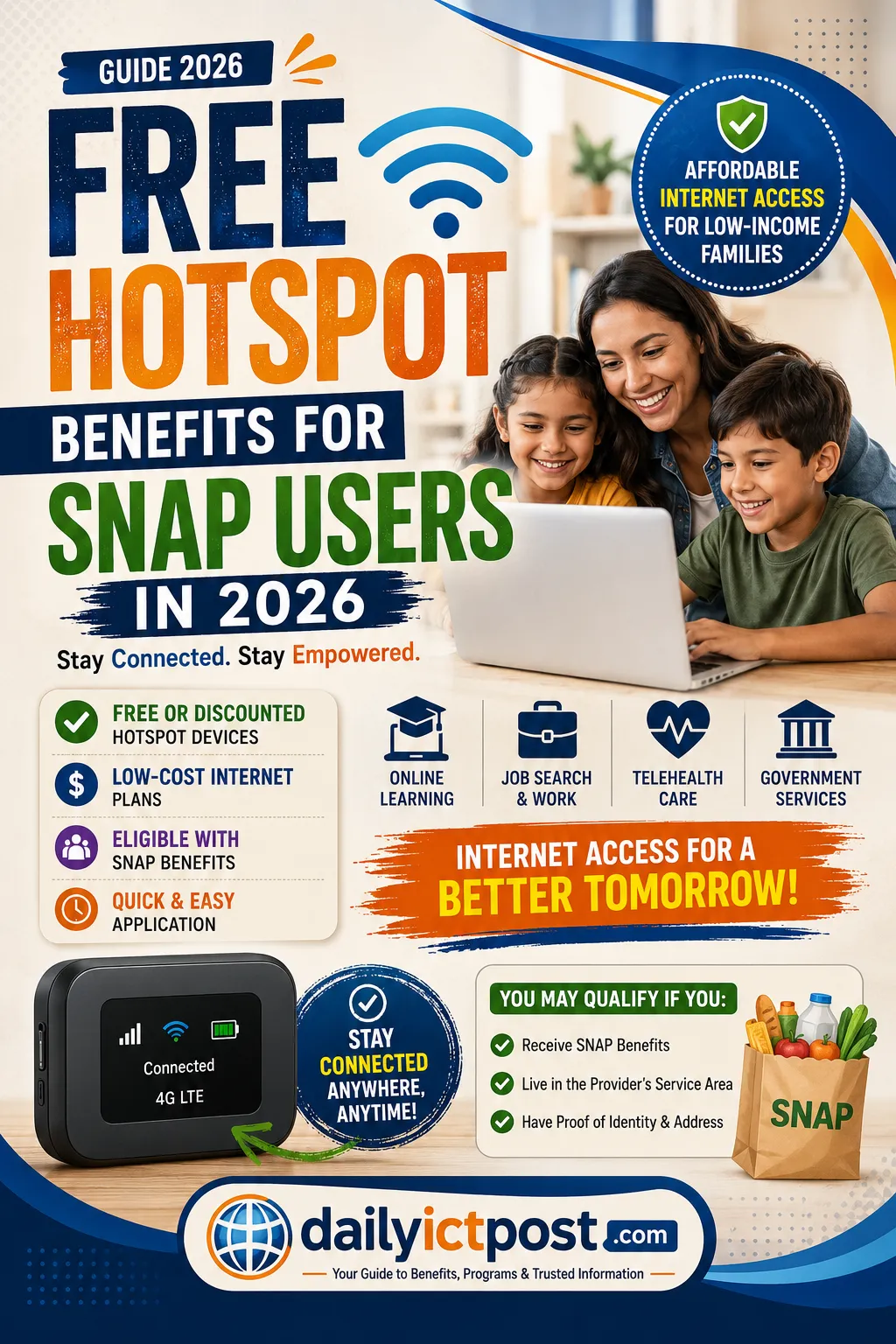
Reliable internet access has become a basic necessity for many American households. Whether you’re applying for jobs, helping children with schoolwork, attending telehealth appointments, or managing government benefits online, staying connected matters.
From job applications to telehealth appointments, staying connected is no longer optional. Here’s what SNAP recipients should know about free hotspot and internet assistance opportunities available in 2026.
For families receiving SNAP benefits, paying for internet service can be challenging. Fortunately, many internet providers, nonprofit organizations, libraries, and community programs continue to offer free or low-cost hotspot options for eligible households in 2026.
If you’re looking for free hotspot benefits for SNAP users in 2026, this guide explains how these programs work, who may qualify, and what to expect during the application process.
Quick Overview: Free Hotspot Benefits for SNAP Users 2026
SNAP recipients may qualify for free or discounted hotspot programs.
Eligibility usually requires active SNAP participation and identity verification.
Available options include mobile hotspots, low-cost internet plans, and nonprofit assistance programs.
Approval may take 1–14 business days depending on the provider.
Program availability varies by state and service area.
Editorial Disclaimer:
This article is for informational purposes only and does not guarantee eligibility, approval, or device availability. Internet assistance programs, provider offers, funding, and qualification requirements may change at any time. Readers should verify all information directly with official providers, nonprofit organizations, or government resources before applying.
Free Hotspot Benefits for SNAP Users 2026 Guide- Eligibility, Providers & How to Apply
How Free Hotspot Benefits Work for SNAP Recipients
Many internet assistance programs use SNAP participation as one way to verify eligibility for discounted connectivity services.
Depending on the provider and your location, available benefits may include:
Free mobile hotspot devices
Discounted wireless internet plans
Reduced monthly internet costs
Mobile data plans with generous data allowances
Alternative internet options for households without broadband access
These programs are designed to help low-income households stay connected to essential online services. For people living in rural areas or places where traditional broadband is limited, a mobile hotspot can often be a practical solution.
Since programs vary by provider and state, available benefits may differ from one location to another.
Why Affordable Internet Access Matters for Low-Income Families
Affordable internet access helps low-income families stay connected to essential services. Many people now use the internet for telehealth appointments, remote work, job applications, online school learning, and government benefits.
Students often need reliable internet for homework and virtual classes. Parents use it to apply for jobs, manage benefits, and access healthcare services from home.
According to pewresearch.org , about 43% of adults earning under $30,000 annually do not have home broadband service.
The fcc.gov has also reported that broadband access remains a major challenge for many low-income households.
Affordable internet can improve access to education, healthcare, employment opportunities, and government services while helping families stay connected in daily life.
Free hotspots can help temporarily, but many families need reliable home internet for work, school, and healthcare. Several low income internet programs offer monthly savings through participating internet service providers.
Many households qualify for home internet discounts that reduce broadband costs and improve online access. Some providers also offer affordable internet plans with no long-term contracts and lower monthly fees.
Families looking for stable connectivity should compare available broadband assistance programs in their area. These programs can make home internet more affordable while providing faster and more dependable service than public Wi-Fi or temporary hotspots.
Many internet providers now offer affordable broadband plans for low-income households that cost significantly less than standard home internet service.
Learn more about available options through fcc.gov.
N.b: Program availability changes frequently and may vary by location.
Although internet assistance programs have changed over the years, many providers and local organizations still offer affordable connectivity options for households that receive SNAP benefits.
Availability often depends on local funding, provider participation, and service coverage. That’s why it’s important to review current program details before applying.
Checking multiple options in your area can help you find the best combination of device support and affordable internet service.
Who Qualifies for Free Hotspot Benefits?
SNAP participation is one of the most common ways to qualify for internet assistance programs.
If you checked all five boxes, you may qualify for one or more internet assistance programs.
Expected Approval and Delivery Timeline
Stage
Typical Time
Application Submission
Same Day
Eligibility Review
1–10 Business Days
Approval Notification
1–7 Days
Device Shipping
3–14 Business Days
Service Activation
Same Day to 48 Hours
These timelines are estimates. Actual processing times may vary based on application volume, document verification, and shipping availability.
Free Hotspot vs Low-Cost Home Internet
Feature
Hotspot
Home Internet
Mobility
High
Low
Setup
Easy
Moderate
Speed
Medium
Higher
Rural Use
Good
Depends
Streaming
Limited
Better
Benefits of Having a Free Hotspot
A hotspot can provide internet access when home broadband is unavailable or unaffordable.
Many SNAP recipients use hotspot services to:
Search and apply for jobs
Attend virtual interviews
Complete online classes and homework
Access telehealth services
Manage government benefits
Stay connected with family and support networks
Reliable internet access can make everyday tasks easier and create more opportunities for education and employment.
For households with limited resources, a hotspot may serve as an important connection to essential services.
Common Mistakes That Delay Approval
Many applications are delayed because of avoidable mistakes.
Common issues include:
Uploading unclear or incomplete documents
Using expired identification
Providing outdated SNAP information
Entering an incorrect address
Submitting multiple applications for the same household
Taking a few extra minutes to review your application can help speed up the approval process.
Quick Facts About Free Hotspot Benefits
At a Glance
Fact
Information
SNAP Accepted as Eligibility?
Yes, by many programs
Credit Check Required?
Usually No
Device Cost
Often Free or Discounted
Contract Required?
Depends on Provider
Data Limits
Varies by Program
Home Broadband Needed?
No
Common Situation
Many SNAP households use hotspot assistance programs when home broadband is unavailable or too expensive. These programs are often used for online learning, telehealth visits, and job searches.
Expert Tips Before You Apply
Keep your SNAP documentation current.
Compare multiple programs before choosing one.
Check coverage maps if you live in a rural area.
Review data limits and service terms carefully.
Save copies of all submitted documents.
Ask local libraries and community organizations about hotspot lending programs.
A little preparation can help you find the most suitable option and avoid unnecessary delays.
So, before applying, compare both hotspot programs and low-cost broadband plans. In some areas, a discounted home internet plan may provide better long-term value than a mobile hotspot, especially for households with multiple users or students.
Quick Facts Summary
SNAP benefits are commonly accepted for internet assistance eligibility.
Many programs offer free or discounted hotspot devices.
Most applications require proof of eligibility and identity.
Approval timelines often range from a few days to two weeks.
Available benefits vary by provider and location.
Frequently Asked Questions
Can I get a free hotspot if I receive SNAP benefits?
Many internet assistance programs accept SNAP participation as a qualifying factor. Availability depends on your location and the provider’s eligibility rules.
Is an EBT card enough to qualify?
Some providers may accept an EBT card, while others require additional proof such as a SNAP approval letter or benefits statement.
Are hotspot devices completely free?
Some programs provide devices at no cost, while others offer discounted equipment or low-cost internet bundles.
Can I use a hotspot for school and work?
Yes. Hotspots are commonly used for online learning, remote work, virtual meetings, job applications, and everyday internet access.
How long does approval take?
Many applications are processed within a few business days, though timelines vary by provider.
Do hotspot programs have data limits?
It depends on the program. Some plans offer unlimited data, while others include monthly data allowances.
Does SNAP Automatically Qualify You for Internet Assistance?
Not always. SNAP eligibility often helps you qualify, but you may still need to apply separately.
Can I Get a Hotspot Without Home Internet?
Yes. A mobile hotspot can provide internet access without a traditional home internet plan.
Are Free Hotspot Programs Available in Every State?
Availability varies by provider and program, but most states have at least some low-cost or free connectivity options.
What Documents Do I Need to Verify SNAP Eligibility?
Typically, you’ll need proof of SNAP enrollment, identity, and sometimes proof of address.
Is the Affordable Connectivity Program Still Available in 2026?
No. The Affordable Connectivity Program (ACP) ended in 2024 and is not available in 2026.
Which hotspot program offers the most data?
The amount of data varies by program. Some offer unlimited data, while others provide monthly data limits.
Can multiple people in one household use the hotspot?
Yes. Most hotspots allow multiple devices to connect at the same time.
Can I use a hotspot for telehealth appointments?
Yes. A hotspot can be used for video calls, telehealth visits, and other online healthcare services.
Do libraries still lend hotspots in 2026?
Yes. Many public libraries continue to offer hotspot lending programs in 2026.
How We Researched This Guide
This guide was created using publicly available information from internet providers, nonprofit organizations, FCC resources, and digital inclusion programs available as of 2026.
Program details may change over time, so readers should verify current information directly through official sources.
Conclusion
Free hotspot benefits for SNAP users in 2026 can help eligible households access the internet without adding significant monthly expenses. While program availability differs by provider and location, many organizations continue to offer affordable connectivity options for low-income families.
If you currently receive SNAP benefits, take time to compare available programs in your area, gather the required documents, and review eligibility requirements carefully. Finding the right hotspot program can help you stay connected to education, employment opportunities, healthcare services, and other essential online resources.
The dailyictpost.com team presents job recruitment notices, various government and private job question solutions, government post activities and technology-based information in simple and practical language. Along with this, we explain ICT, mobile, computer, apps, online income, digital tools, government services, national elections and cyber security-related issues in such a way that the reader can understand and learn.
We believe that learning technology is not difficult, if it is explained correctly. Therefore, we present complex topics like using new software, mobile settings or digital marketing step by step in such a language that it feels like someone is sitting next to you and explaining it in a simple way.
Our goal is only one - that the reader gets accurate information, learns with confidence and can use that knowledge in real life.