Fact-Checked: Information reviewed against provider websites
SNAP eligibility references cross-checked with USDA guidance
Last reviewed: June 2026
Following the closure of the federal Affordable Connectivity Program, securing reliable home internet on a tight budget has become a major challenge. After the Affordable Connectivity Program ended, many families began looking for affordable alternatives to keep their home internet service.
Fortunately, the nation’s two largest telecom giants have stepped up. Many low-income households that participate in SNAP may qualify for discounted internet programs offered by telecommunications companies. Eligibility requirements can vary based on location, service availability, household status, and the provider’s current program rules. Choosing the right provider can save you hundreds of dollars while delivering the speeds you need for remote work and online schooling.
According to USDA SNAP guidelines, participation in SNAP can help households qualify for certain low-income assistance programs offered by internet providers.
Program availability, pricing, speeds, eligibility requirements, installation fees, and equipment policies can change at any time.
Information in this article is based on publicly available provider and government resources reviewed in June 2026. Readers should always verify current details directly through Verizon, AT&T, USAC, Lifeline, or other official sources before enrolling.
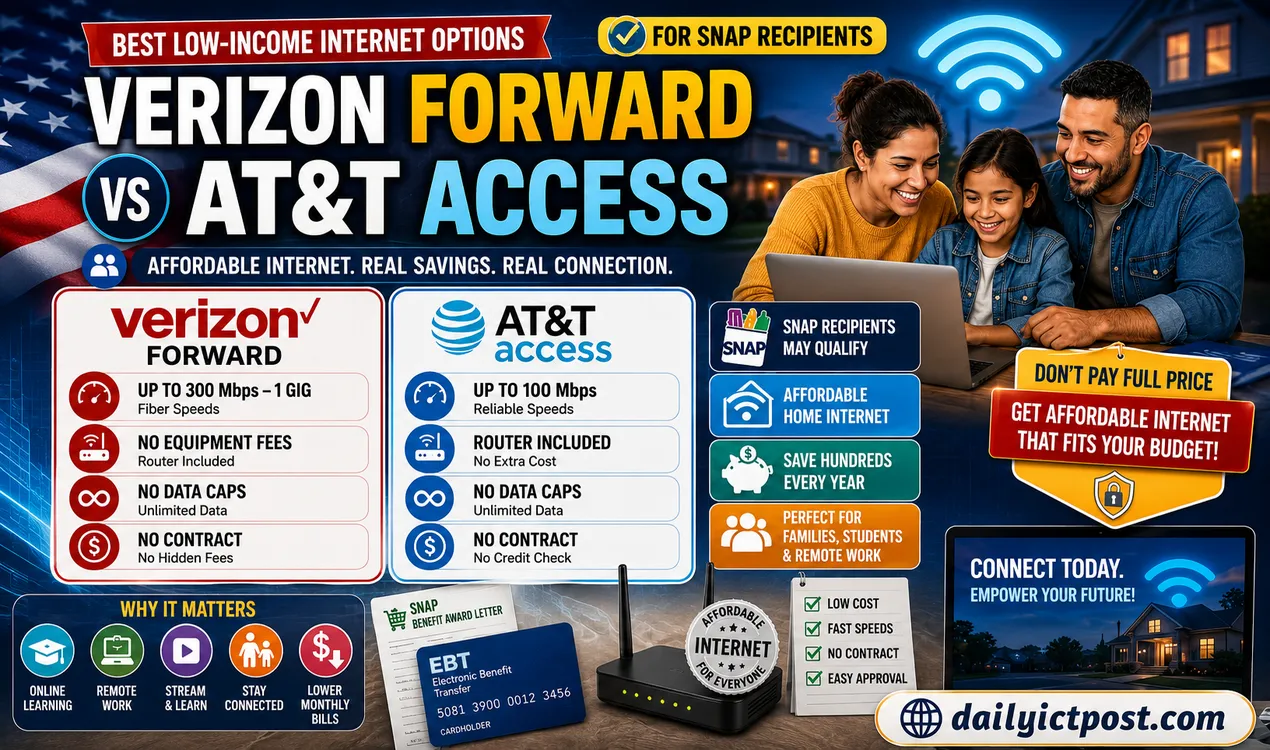
Verizon Forward vs AT&T Access: Best Low-Income Internet for EBT in 2026
Quick Overview: The Final Verdict
Choose Verizon Forward:
If you want fiber-optic speeds with absolutely zero equipment fees and no data caps. It is the best choice for heavy streamers and gamers.
Fiber available at your address
Multiple users stream daily
Remote work requires faster upload speeds
Choose AT&T Access:
If you live in an area where fiber is not available. Their tiered pricing (starting at just $30) makes it a flexible option for tight monthly budgets.
Rural coverage is more important
Fiber unavailable locally
A lower-cost entry plan is preferred
The Verizon Forward Program
Verizon offers discounted home internet options for qualifying households through its assistance initiatives. Available plans, speeds, and pricing may differ depending on whether Verizon Fios fiber or 5G Home Internet service is available at the applicant’s address. The Verizon Forward program utilizes its cutting-edge Fios (fiber-optic) network and its 5G Home Internet towers to deliver massive speeds at budget prices.
If you qualify via your EBT status, Verizon strips away the confusing pricing tiers. You simply receive their standard high-speed home internet packages at a heavily subsidized flat rate. Depending on your home address, this means you could access symmetrical gigabit speeds for less than half the price your neighbors pay.
The biggest advantage of Verizon Forward is the lack of hidden fees. They do not charge a monthly router rental fee, there are no annual contracts to sign, and they do not enforce data caps. Your kids can download large school files and stream educational videos without you ever having to worry about an overage charge.
Access from AT&T remains a powerhouse in the low-income broadband space. While Verizon relies heavily on its expanding fiber network, AT&T has a massive, established footprint covering both urban and highly rural areas where fiber cables have not yet been buried.
In 2026, the Access program offers a straightforward pricing model. For a flat rate of $30 per month, qualifying SNAP recipients receive speeds up to 100 Mbps. If 100 Mbps is not technically available at your specific street address, AT&T drops the price to an incredibly cheap $10-$30 range for their legacy lower-speed tiers.
Similar to Verizon, AT&T includes the Wi-Fi gateway (router) in the monthly price, avoiding sneaky hardware rental fees. They also completely waive installation fees and do not require a credit check, making it extremely easy for families struggling with past debts to get connected.
Note: Pricing and speed availability vary by location and may change over time. Always verify current offers directly on the provider’s official website.
Internet Recommendation
Household Situation
Recommended Plan
Family A
• 2 adults
• 2 students
• Daily Zoom classes
• Netflix streaming
Verizon Fiber
Family B
• Single parent
• Rural county
• Basic web browsing
AT&T Access
How to Prove Your EBT Eligibility
Neither Verizon nor AT&T will simply take your word for it. You must provide legal documentation proving your low-income status. The fastest and most efficient way to get approved by either company is by leveraging the government’s central verification database.
We highly recommend securing a federal approval code first. Visit the official USAC National Verifier website. Upload a clear photograph of your current SNAP benefit award letter and your state ID. After completing verification through the National Verifier, eligible applicants may use their approved status when enrolling with participating providers. Final approval remains subject to provider-specific requirements and service availability.
Who Should Choose Verizon Forward?
Choose Verizon Forward if:
Verizon Fios is available
Multiple family members stream daily
You work from home
You need faster upload speeds
Who Should Choose AT&T Access?
Choose AT&T Access if:
Fiber is unavailable
You live in a rural area
You want broader service availability
You prefer a lower-speed, affordable plan
Other Low-Income Internet Programs Worth Considering
Xfinity Internet Essentials
Spectrum Internet Assist
Cox Connect2Compete
Optimum Advantage Internet
What Happened After the Affordable Connectivity Program Ended?
When the Affordable Connectivity Program (ACP) ended in June 2024 due to exhausted funding, Congress did not renew the $30 monthly subsidy. This abruptly affected 23 million American households. Consequently, an estimated 5 million homes were entirely disconnected from the internet. Meanwhile, 18 million faced sudden bill hikes or were downgraded to slower speeds, forcing tough financial choices between vital connectivity and daily essentials.
Without the ACP funding, available alternatives are strictly limited. The federal Lifeline program remains, offering a much smaller $9.25 monthly discount. Dedicated charitable groups now provide discounted hotspots, while municipal libraries offer localized support.
Additionally, major Internet Service Providers (ISPs) actively maintain their own affordable tiers. Programs like Xfinity Internet Essentials, Spectrum Internet Assist, and Access from AT&T lock in discounted rates between $10 and $30 per month. To qualify, households must apply directly to the provider and demonstrate active enrollment in assistance programs such as SNAP or Medicaid.
CRITICAL PAYMENT WARNING
Do not attempt to pay your monthly internet bill with your actual EBT card. Federal law restricts SNAP funds exclusively to approved food purchases. While your EBT card acts as proof of your low income to secure the discount, you must provide a standard checking account, credit card, or prepaid debit card to cover the remaining $20 to $30 monthly utility bill.
Frequently Asked Questions
Can I apply if I have an old, unpaid bill with AT&T or Verizon?
Yes. In 2026, both corporate assistance programs waived their strict legacy debt policies. Even if you have a previous balance or a poor credit score, you can still enroll in either the Verizon Forward or Access from AT&T programs without being denied.
Do these programs include a free government tablet?
No. Verizon Forward and AT&T Access are strictly home internet connectivity programs. They provide the Wi-Fi router, but they do not distribute physical tablets, laptops, or smartphones. You must secure those devices through separate hardware-focused Lifeline providers.
Is Verizon Forward available in every state?
No. Verizon Forward is a discount applied to Verizon’s existing internet services (like Fios, 5G Home, or LTE Home). Fios is heavily concentrated in the mid-Atlantic and New England regions, and while their 5G Home internet is expanding, the network does not yet cover every state.
Can SNAP recipients get internet discounts without ACP?
Yes. Even though the Affordable Connectivity Program (ACP) ended in June 2024, SNAP recipients still qualify for the federal Lifeline program, which provides up to a $9.25/month discount. Additionally, many major internet service providers continue to offer their own dedicated low-income plans for SNAP participants, including:
Xfinity (Internet Essentials)
Spectrum (Internet Assist)
AT&T (Access from AT&T)
Cox (Connect2Compete)
What documents are needed to verify SNAP participation?
To prove your SNAP enrollment for an internet discount, you generally need an official document from your state’s social services agency. This is usually a recent benefit award letter or a statement of benefits that clearly displays:
Your full name
The name of the qualifying program (SNAP)
The dates of your active eligibility (showing the benefits are current)
Does having an EBT card guarantee approval?
No. Simply possessing an EBT card does not guarantee approval, and most providers will not accept a picture of the card itself as proof of eligibility because it doesn’t show your active benefit dates. You must submit your official award letter. Furthermore, you must actually live within the provider’s service footprint and pass their internal checks, which sometimes include not having an outstanding, unpaid balance with that provider.
Which provider offers better speeds for online school?
Providers offering low-income discounts on fiber-optic networks will give you the best speeds and reliability for online schooling.
Top Tier (Fiber): Plans like Verizon Forward and AT&T Access apply discounts to fiber connections, offering speeds from 300 Mbps to 1 Gigabit (1,000 Mbps).
Second Tier (Cable): If fiber is unavailable where you live, cable providers like Xfinity Internet Essentials (up to 100 Mbps) or Spectrum Internet Assist (up to 50 Mbps) are generally the next best options and still offer plenty of speed for remote learning and Zoom calls.
The Final Verdict
Ultimately, your physical home address dictates the winner of this matchup. If you live in a modern metropolitan area where the Verizon Fios network is active, Verizon Forward may offer greater value for households with Verizon Fios due to higher fiber speeds and included equipment.
However, if you live outside the major tech hubs, AT&T Access remains a highly reliable, incredibly affordable lifeline that guarantees you stay connected. Gather your SNAP documentation today, check your local zip code availability on both corporate websites, and lock in your permanent internet savings.
Editorial Note
We independently research low-income assistance programs using official provider and government sources. We do not receive compensation from Verizon, AT&T, or any provider mentioned in this article.
The dailyictpost.com team presents job recruitment notices, various government and private job question solutions, government post activities and technology-based information in simple and practical language. Along with this, we explain ICT, mobile, computer, apps, online income, digital tools, government services, national elections and cyber security-related issues in such a way that the reader can understand and learn.
We believe that learning technology is not difficult, if it is explained correctly. Therefore, we present complex topics like using new software, mobile settings or digital marketing step by step in such a language that it feels like someone is sitting next to you and explaining it in a simple way.
Our goal is only one - that the reader gets accurate information, learns with confidence and can use that knowledge in real life.