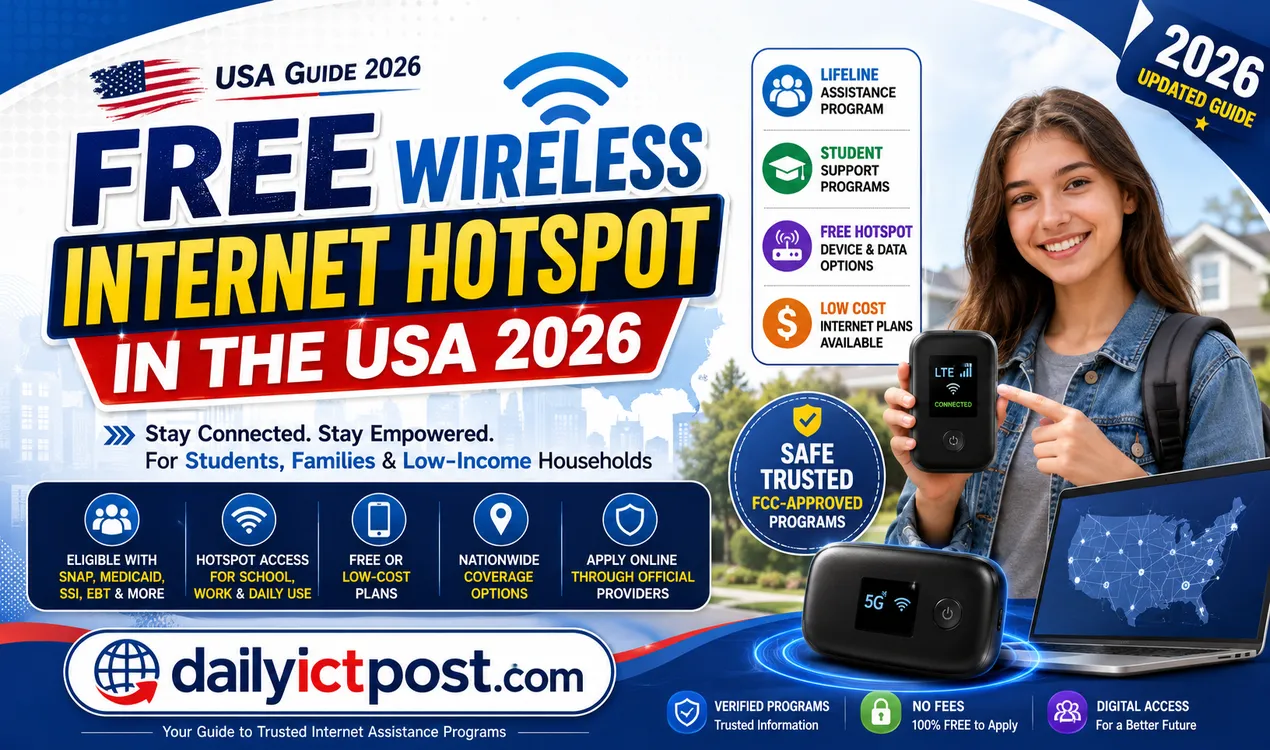
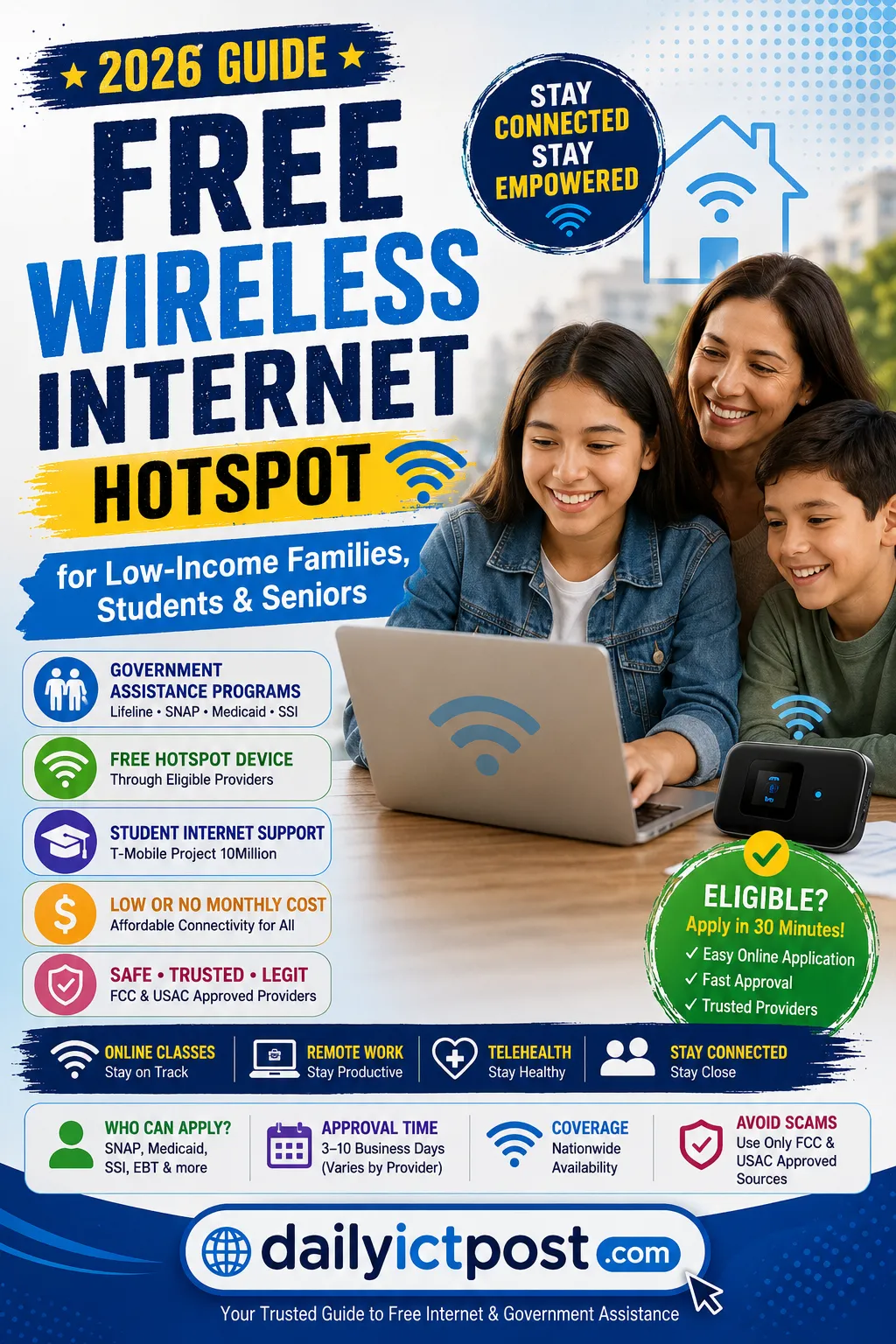
In 2026, many families still struggle to afford reliable internet at home. While broadband prices continue rising in some areas, several federally funded internet assistance and government-backed connectivity programs still help eligible families stay connected through free wireless hotspot access, discounted mobile data plans, and hotspot-enabled devices.
After the Affordable Connectivity Program (ACP) ended, many households started looking for alternative low-income connectivity assistance options through Lifeline providers, student internet initiatives, and wireless carriers offering broadband affordability support.
However, provider availability, hotspot limits, and coverage quality can vary depending on location, network type, and state participation rules.
Let’s break down the safest and most trusted Free Wireless Internet Hotspot in the USA 2026, including eligibility requirements, FCC-approved providers, student hotspot support, and how to apply through official sources without risking scams or misleading third-party websites.
Quick Overview: Free Wireless Internet Hotspot in the USA 2026
Feature
Details
Main Program
Lifeline Assistance Program
Available In
Most USA states
Eligible Users
SNAP, Medicaid, SSI, EBT, low-income households
Free Hotspot Device
Available through selected providers
Student Internet Support
T-Mobile Project 10Million
Monthly Cost
Free or very low-cost
Application Process
Online through approved providers
Best For
Students, remote workers, and low-income families
Quick Steps to Apply for a Free Wireless Hotspot in 2026
1. Check Lifeline eligibility
2. Gather SNAP/Medicaid proof
3. Compare provider coverage in your ZIP code
4. Apply through an FCC-approved provider
5. Wait for approval and device shipment
Most applications take 10–30 minutes online.
Best Option by User Type:
Students → Project 10Million
SNAP users → Lifeline providers
Rural households → Verizon-based carriers
Seniors → Medicaid-supported plans
Quick Reality Check
Most free hotspot plans are NOT unlimited
Coverage quality depends heavily on ZIP code
Device availability changes weekly
Hotspot throttling policies vary by provider
SNAP eligibility rules are managed federally through USDA guidelines.
Free Wireless Internet Hotspot in the USA 2026 (How Thousands Are Getting Free 5G Internet)
Best Free Wireless Internet Hotspot in the USA 2026
Lifeline Free Wireless Hotspot Assistance
The Lifeline program remains one of the most important federal broadband assistance programs available for eligible low-income households in 2026. Supported through federal communications support initiatives, Lifeline helps qualifying users access discounted wireless service, mobile broadband support, and limited hotspot functionality through participating carriers.
Depending on the provider and state, users may receive hotspot-enabled smartphones, limited monthly hotspot data, or discounted mobile internet access designed for schoolwork, telehealth appointments, job searching, and everyday communication needs.
However, hotspot availability and high-speed data limits vary significantly between providers. Some carriers only support basic hotspot usage, while others place monthly throttling restrictions after certain data limits are reached.
Before enrolling, users should compare coverage maps, supported devices, activation requirements, and network reliability in their local area. Rural households and underserved communities may experience different performance levels depending on carrier infrastructure and regional signal coverage.
Project 10Million continues to help K-12 students who do not have reliable internet access at home. Eligible families may receive a free hotspot device along with yearly high-speed data support.
The program is mainly designed for students who need internet access for online classes, homework, and educational platforms. Many schools work directly with T-Mobile to simplify the application process for families.
Availability can vary by school district, so parents should check directly with their school or the official provider website before applying.
In rural areas, some users report better hotspot reliability through Verizon-based providers compared to T-Mobile-only coverage zones.
Several wireless companies now offer low-cost hotspot plans for low-income households. These plans are often cheaper than standard mobile internet packages and may include hotspot access, unlimited talk, and texting benefits.
Some providers offer hotspot-enabled smartphones instead of separate hotspot devices. Others focus more on flexible prepaid plans with limited monthly data.
In some ZIP codes, users report strong speeds during daytime hours but slower hotspot performance at night when local towers become congested. Comparing providers before enrolling can help users avoid slow speeds or weak signal issues in their area.
Since the Affordable Connectivity Program ended, many households have started searching for alternative broadband affordability programs and low-income wireless internet solutions. As a result, Lifeline-supported mobile broadband access and student connectivity programs have become increasingly important for digital equity across the United States.
ACP ended
Lifeline still active
schools expanding hotspot access
carriers changing data policies
Free Wireless Hotspot Providers Comparison 2026
Not every free hotspot provider offers the same level of wireless internet performance. Some carriers focus on affordability and basic connectivity, while others provide stronger hotspot support with better mobile broadband speeds and wider nationwide coverage.
Free Wireless Internet Hotspot in the USA 2026
Users living in rural America or areas with weak carrier infrastructure should pay close attention to network type, signal reliability, and monthly hotspot limitations before applying.
In practice, many applicants notice that hotspot performance depends more on local carrier congestion than advertised speeds. A provider that works well in one ZIP code may perform poorly only a few miles away.
Some users also report that “unlimited” hotspot plans become slower after high-speed data thresholds are reached, especially during evenings or in crowded urban areas.
Who Qualifies for Free Wireless Internet Hotspot?
SNAP and EBT Recipients
People receiving SNAP or EBT benefits are among the most common applicants for free hotspot programs. These benefits are widely accepted for Lifeline eligibility verification.
Most providers require proof of participation during the application process. Many companies now allow digital uploads, which makes approval faster and easier.
Once approved, users may receive free monthly data, hotspot access, or discounted wireless service depending on the provider.
Users enrolled in Medicaid or SSI programs may also qualify for free wireless hotspot assistance in 2026. These programs help providers confirm financial eligibility for internet support services.
Many carriers now offer online applications that can be completed from home. This has made the process easier for seniors, disabled users, and families without transportation access.
The amount of hotspot data available depends on the carrier, state, and selected plan.
Students and Low-Income Families
Students from low-income households remain one of the biggest groups supported by free hotspot programs. Schools and wireless companies continue expanding internet access support across many states.
Wireless hotspot internet can help students attend online classes, complete homework, and access educational resources without relying on expensive broadband plans.
Families living in rural areas may benefit the most where traditional home internet service is limited or unavailable.
How to Apply for Free Wireless Internet Hotspot in 2026
Applications for low-income internet accessibility programs should always be completed through official government websites or verified wireless providers. Many fake third-party websites now imitate legitimate assistance programs and may request sensitive personal information or unnecessary payments.
To reduce fraud risks, applicants should verify provider legitimacy through FCC-approved resources and secure online application systems before submitting identity documents or public benefit eligibility verification records.
Before Applying Checklist
Verify eligibility first.
Compare provider coverage maps.
Check hotspot data caps.
Avoid unofficial third-party websites.
Prepare SNAP/Medicaid proof documents.
How to Check Eligibility for Free Wireless Hotspot Programs
Before applying, users should confirm whether they qualify through the Lifeline program or another approved low-income internet program.
Eligibility is usually based on household income or participation in programs such as SNAP, Medicaid, SSI, or Federal Public Housing Assistance.
Applicants normally need identification documents and proof of benefits during the verification process.
Not every provider offers the same hotspot features. Some include limited hotspot access, while others provide better monthly data allowances or separate hotspot devices.
Users should compare data limits, network coverage, activation requirements, and supported devices before choosing a plan.
Taking a few extra minutes to compare providers can help avoid slow internet speeds or unexpected restrictions later.
Apply Through Official Sources
Applications should always be completed through official provider or government websites. Avoid unofficial third-party sites that request payments or unnecessary personal information.
Most providers allow online registration with digital document uploads. Some companies also offer customer support to help applicants complete the process.
After approval, users should monitor monthly data usage to avoid interruptions or reduced speeds.
Student hotspot programs: Depends on school district.
Nonprofit device programs: 1–4 weeks.
Important Reality Check About Free Hotspot Programs
Many free wireless hotspot programs help households reduce internet costs, but users should still understand the practical limitations before applying.
Some providers only offer limited monthly high-speed hotspot data rather than unlimited internet access. After the data limit is reached, speeds may slow significantly depending on carrier policies and local network congestion.
In some areas, hotspot support is only available through smartphones rather than separate portable hotspot devices. Coverage quality may also vary between urban neighborhoods, rural communities, and underserved regions with weaker carrier infrastructure.
Families relying on hotspot internet for remote work, online classes, or video streaming should compare network reliability, throttling policies, and signal strength carefully before selecting a provider.
Important Reality Check at a glance:
Most free hotspot programs have limited monthly high-speed data.
Coverage quality depends on your area.
Separate hotspot devices are not guaranteed.
Some providers only offer a hotspot through smartphones.
Data speeds may slow after monthly usage limits.
Who Should Compare Providers Carefully?
Rural households with weak T-Mobile coverage.
Heavy video streamers needing large hotspot data.
Families needing multiple connected devices.
Remote workers relying on stable speeds.
What Most Free Hotspot Programs Do NOT Tell You
Many “free hotspot” offers only include limited high-speed data.
Speeds may slow after data caps.
Coverage quality depends on your ZIP code.
Some providers offer phones with hotspot access instead of separate hotspot devices.
Choosing providers without checking local coverage.
Uploading blurry SNAP/Medicaid documents.
Official Programs Mentioned in This Guide
Program
Managed By
Lifeline
FCC + USAC
SNAP
USDA
Project 10Million
T-Mobile
Medicaid
State/Federal Agencies
Frequently Asked Questions
What is the best free wireless hotspot program in the USA for 2026?
The Lifeline program remains the most widely available and trusted option for eligible low-income households.
Can I get a free hotspot device from the government?
Some providers and student internet programs offer free hotspot devices for eligible users.
Is the ACP program still available in 2026?
No. The Affordable Connectivity Program ended after federal funding expired in 2024.
Who qualifies for free hotspot internet?
People receiving SNAP, Medicaid, SSI, Federal Public Housing Assistance, or similar benefits may qualify.
Do Lifeline providers offer unlimited hotspot data?
Most providers offer limited hotspot data rather than unlimited access. Data limits vary by company.
Can students receive free hotspot internet?
Yes. Eligible students may qualify through school-supported internet programs or wireless education initiatives.
Which provider offers strong hotspot support?
Project 10Million and some Lifeline-supported carriers currently provide better hotspot support for eligible users.
Is hotspot internet good enough for online classes?
For basic online learning, homework, video calls, and browsing, hotspot internet is usually enough if the data allowance is reasonable.
Can I apply online for free hotspot programs?
Yes. Most Lifeline-supported providers now allow online applications with digital verification documents. Applicants usually need proof of identity and eligibility documents such as SNAP or Medicaid participation records.
Are free wireless hotspot programs available nationwide?
Most states have participating providers, but plans and hotspot features can vary depending on location.
Final Thoughts
Free wireless internet hotspot in the USA 2026 programs continue playing an important role in improving digital access for low-income households, students, seniors, and underserved communities across the United States in 2026. Although ACP funding ended, several government-backed connectivity programs and low-income broadband assistance options still help eligible users access affordable mobile internet services.
Before applying, households should compare provider coverage, hotspot data policies, device support, and network reliability carefully. Choosing the right wireless provider can significantly improve online learning access, remote work flexibility, telehealth communication, and everyday digital connectivity.
For the safest experience, always apply through official provider websites or trusted government resources and avoid unofficial third-party platforms requesting unnecessary payments or sensitive information.
Editorial Disclaimer
This editorial guide is independently researched and updated for informational purposes only. Program availability, hotspot device inventory, Lifeline participation, wireless coverage, eligibility requirements, and monthly data policies may change over time depending on FCC regulations, carrier decisions, federal funding availability, and state participation rules.
We do not represent any government agency, wireless provider, or federal benefits office. Readers should always verify current program details directly through official FCC resources, USAC-approved Lifeline providers, school districts, or participating wireless carriers before submitting applications or sensitive documents.
Wireless performance, hotspot speeds, and coverage quality may vary significantly depending on ZIP code, carrier congestion, local infrastructure, and device compatibility.
Important Note
Approval, device availability, and hotspot features are never guaranteed and may vary depending on provider inventory, state participation, and eligibility verification.
The dailyictpost.com team presents job recruitment notices, various government and private job question solutions, government post activities and technology-based information in simple and practical language. Along with this, we explain ICT, mobile, computer, apps, online income, digital tools, government services, national elections and cyber security-related issues in such a way that the reader can understand and learn.
We believe that learning technology is not difficult, if it is explained correctly. Therefore, we present complex topics like using new software, mobile settings or digital marketing step by step in such a language that it feels like someone is sitting next to you and explaining it in a simple way.
Our goal is only one - that the reader gets accurate information, learns with confidence and can use that knowledge in real life.