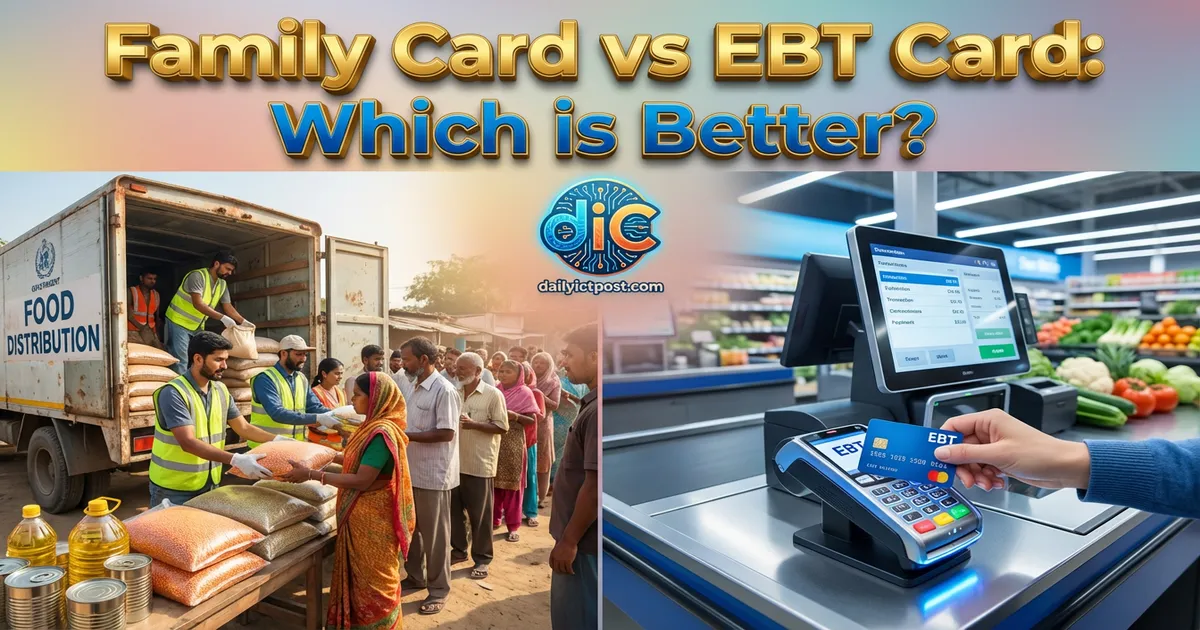
If you’re comparing Family Card vs EBT Card and wondering which is better, the answer depends entirely on where you live and how each system supports low-income families.
In short:
The EBT card in the USA offers flexible, debit-style grocery spending.
The Family Card in Bangladesh provides fixed essential goods at government-controlled prices.
In this detailed comparison, we’ll break down eligibility, flexibility, benefits, purchasing power, and long-term stability so you can clearly understand the difference between Family Card and EBT Card systems.
Quick Answer:
The EBT card offers more flexibility and purchasing power in the USA, while the Family Card provides price-controlled essential goods in Bangladesh. The better option depends on the country’s economic system.
The Family Card is a government initiative heavily used in developing nations, most notably in Bangladesh. It allows low-income households to buy essential food items at highly subsidized rates. The Trading Corporation of Bangladesh (TCB) manages this distribution to help stabilize local market prices and keep food affordable.
Government assistance programs exist to help families during tough financial times. To truly understand the difference between these two systems, we first need to look at how they operate on a basic level.
What is an EBT Card?
In the United States, an EBT (Electronic Benefits Transfer) card is the primary tool for distributing welfare benefits. State departments issue these magnetically encoded payment cards, which work just like regular debit cards. They are usually funded by programs like SNAP (Supplemental Nutrition Assistance Program). You can find more details on the official USDA SNAP page.
The Family Card vs EBT Card Comparison:
Knowing the difference between Family Card and EBT Card systems is helpful for anyone looking into global food assistance. Both programs share the same goal of fighting hunger. However, the way they are funded, managed, and used by families is very different.
Here is a quick visual summary of the Family Card vs EBT Card comparison.
Feature
Family Card (Bangladesh)
EBT Card (USA)
Primary Method
Subsidized physical goods
Digital cash equivalent
Funding Source
Government TCB
Federal Government (USDA)
Flexibility
Low (specific items only)
High (any approved grocery item)
Ease of Use
Requires waiting in line
Swipe at checkout like a debit card
Fraud Risk
Physical card theft
Digital skimming
Exploring the Core Differences
The biggest contrast comes down to flexibility. A Family Card restricts shoppers to specific subsidized items, usually bought directly from designated trucks or dealers. An EBT card, on the other hand, gives users the freedom to shop at almost any standard grocery store for a wide range of approved foods.
Family Card Bangladesh vs EBT USA Which is Better?
When comparing Family Card Bangladesh vs EBT USA to see which is better, we have to factor in the local economy. In Bangladesh, the Family Card system physically distributes essential goods like cooking oil, sugar, and lentils. In the USA, the EBT system injects digital funds directly into the standard retail market.
This regional comparison highlights two distinct solutions. The US system prioritizes shopping flexibility for families. Meanwhile, the Bangladesh system guarantees that people receive actual physical goods, even when inflation makes market prices unpredictable. To explore how global subsidy programs impact local economies, the World Bank is a great resource.
Family Card vs SNAP EBT Differences
Let’s look closely at the specific Family Card vs SNAP EBT differences. SNAP (formerly known as food stamps) assigns a cash value to the EBT card. The Family Card, conversely, provides a set quota on physical grocery items a family can buy.
The Core Financial Support Comparison
In a direct Family Card vs EBT financial support comparison, EBT offers a dynamic monthly dollar amount based on household size and income limits. The Family Card gives families a fixed discount margin on targeted products, meaning they save a predictable amount of cash during each shopping trip.
Family Card and EBT Eligibility Comparison
Who actually gets to use these programs? A closer Family Card and EBT eligibility comparison shows that both systems require applicants to meet strict rules, but the criteria look very different.
Who Qualifies for Family Card vs EBT?
So, who qualifies for Family Card vs EBT? For the Family Card, local representatives in Bangladesh identify households in need based on the neighborhood’s economic conditions. For EBT, the US government relies on the federal poverty level. Applicants must prove they fall under specific income and asset limits. For details on US poverty guidelines, check the Department of Health and Human Services.
Family Card and EBT Application Process Difference
The Family Card and EBT application process difference highlights the tech gap between the two countries. One system is highly digitized, while the other depends heavily on local, in-person administration.
How to Apply for a Family Card
Local ward councilors and municipal leaders typically manage these applications. They build a list of eligible local families, and the physical cards are handed out manually within the community.
EBT applications happen mostly online or at local state department offices. People applying must submit detailed financial paperwork, including recent pay stubs and proof of identity, to get approved.
Family Card vs EBT Benefits List
Here is a clear Family Card vs EBT benefits list to show exactly what recipients get from each program.
Family Card Benefits
Access to daily cooking essentials like oil, sugar, and onions.
Protection against sudden grocery market price spikes.
Guaranteed availability of specific products at designated spots.
The ability to purchase fresh produce, meat, and dairy products.
The freedom to shop at local supermarkets and participating farmers’ markets.
Automatic monthly balance reloads without standing in physical distribution lines.
Access to helpful nutritional education resources.
Family Card Benefits vs EBT Benefits:
When weighing Family Card benefits vs EBT benefits, the biggest trade-off is between structured product distribution and consumer choice.
Monthly Support Difference
The Family Card vs EBT monthly support difference is quite noticeable. An EBT household might receive hundreds of dollars each month to spend on groceries. A Family Card holder saves money by paying below-market rates, but they still need to have their own cash on hand to complete the subsidized purchase.
Family Card Subsidy vs SNAP Benefits
Comparing a Family Card subsidy vs SNAP benefits shows how different governments manage welfare budgets. Subsidies lower the final cost of a physical item. SNAP, however, acts as a total cash replacement at the register.
Food Variety and Purchasing Power
SNAP benefits offer ultimate purchasing power and dietary choice. Subsidies offer controlled, targeted purchasing power to ensure baseline survival needs are met. For more information on dietary needs and food variety, visit the World Health Organization.
Family Card vs Food Stamp Card Historical Context
The history behind the Family Card vs food stamp card is interesting. Food stamps started as actual physical paper booklets in the USA before shifting to the modern EBT system for better security and convenience. The Family Card is a modern version of the classic rationing systems that many countries have used during tough economic times.
Family Card vs EBT Pros and Cons
Every support system has its strong points and drawbacks. Let’s break down the main Family Card vs EBT pros and cons.
Pros of the Family Card
Ensures physical goods go directly to those in need.
Shields low-income households from sudden inflation.
Simple to set up in areas that lack digital payment infrastructure.
Cons of the Family Card
Often requires waiting in long physical lines at designated trucks.
Offers a limited variety of groceries, usually excluding fresh produce or meat.
Buyers must still spend their own cash to get the discounted price.
Provides a massive variety of food choices for families.
Offers a seamless and private shopping experience at regular stores.
Balances update automatically every month.
Cons of the EBT Card
Involves a highly bureaucratic and strict application process.
Funds usually cannot be used to buy hot, ready-to-eat meals.
Carries a risk of digital fraud and card skimming. For tips on avoiding benefit theft, read the FTC Consumer Advice.
Real-Life Case Studies
To figure out the answer to Family Card vs EBT Card Which is Better, it helps to look at the real-world impact on families.
A Family Card Story in Bangladesh
Rahim, a day laborer in Dhaka, uses his Family Card to buy cooking oil and lentils. During holidays like Ramadan, when market prices normally jump, the card saves him enough money to cover his children’s school fees.
An EBT Success Story in the USA
Maria, a single mother in Texas, uses her EBT card at local farmers’ markets. Through programs like “Double Up Food Bucks,” her EBT funds are matched when she buys fresh local produce, making it easier for her kids to eat healthy meals.
Family Card or EBT Card: Which Offers More Stability?
When choosing between a Family Card or EBT Card in terms of stability, they each excel in different areas. EBT provides financial stability by adding funds directly to a household budget. The Family Card provides supply chain stability by making sure the physical food is actually there to buy.
Family Card vs EBT 2026 Updated Comparison Trends
Looking ahead, the Family Card vs EBT 2026 updated comparison reveals that both programs are changing with the times. EBT is rapidly expanding to cover online grocery delivery services. Meanwhile, the Family Card is becoming more digital, utilizing smart ID systems to stop fraud and ensure fair distribution.
Family Card vs EBT Key Differences Explained
Having the Family Card vs EBT key differences explained shows us that the EBT system relies entirely on a strong, pre-existing network of grocery stores. The Family Card steps in to bypass standard retail markets and get goods straight to the consumer.
Family Card or EBT Which is Best for Low Income?
Ultimately, deciding Family Card or EBT which is best for low income depends on where a person lives. In a country with a highly developed retail network, EBT provides a superior, flexible experience. In a developing economy facing potential supply chain disruptions, the Family Card is often the most practical and immediate way to help.
Family Card vs EBT Full Guide to Maximizing Benefits
This Family Card vs EBT full guide would not be complete without a few practical tips for users trying to make the most of their benefits.
Always verify the official distribution dates and locations for your Family Card.
Look for farmers’ markets that offer dollar-matching programs for EBT users.
Always keep your card PIN secure to prevent theft.
Common Misconceptions Addressed
A frequent misunderstanding is that EBT can buy anything in a store. In reality, it cannot be used for alcohol, tobacco, paper towels, or pet food. On the flip side, some people assume the Family Card provides free groceries. It actually provides heavily discounted groceries, meaning the buyer still pays out of pocket.
Economic and Public Health Impact of Both Systems
These government programs do more than just feed people; they impact the entire economy. By spending less on groceries, families have more money left over for housing, healthcare, and education. This creates a positive ripple effect in their communities. Economic research detailing these impacts is available through the Brookings Institution.
Technology continues to improve how these benefits are managed. EBT relies on complex, secure digital payment networks. The Family Card is also modernizing, slowly adopting QR codes and fingerprint scanning to make sure the right families get their allotted goods.
A major goal of food assistance is improving public health. Because the EBT program lets families buy fresh fruits and vegetables, it tends to support better long-term nutrition than the dry goods typically provided by a Family Card. Studies on national nutrition and health are frequently shared by the Centers for Disease Control and Prevention.
Many other nations have built their own systems to fight hunger. India uses a vast ration card network, while several European nations prefer direct cash deposits to families in need. Studying these different approaches helps governments improve both the Family Card and EBT frameworks over time.
Conclusion
So when asking Family Card vs EBT Card Which is Better, the answer depends entirely on the country’s welfare structure and economic stability. When looking at the Cards’ debate, it is clear that both systems are vital lifelines. The true difference between Family Card and EBT Card programs is how they adapt to their local economies. The EBT system allows beneficiaries to purchase any SNAP-approved grocery item at authorized retailers, including fruits, vegetables, dairy, and meat. This provides broader food variety compared to fixed-item subsidy systems.
At the same time, the Bangladesh Family Card acts as a necessary shield against sudden price hikes, making sure essential goods reach vulnerable neighborhoods. In the end, both programs successfully ensure that fewer families go to bed hungry.
Frequently Asked Questions
1. Family Card vs EBT Card Which is Better for buying fresh vegetables?
The EBT card is the better option for fresh produce because it allows users to shop at standard supermarkets and farmers’ markets. The Family Card is mostly limited to dry essentials like oil, sugar, and lentils.
2. What is the main difference between Family Card and EBT Card?
The primary difference is that a Family Card grants access to discounted physical goods from specific government trucks, while an EBT card acts like a digital debit card loaded with funds for a variety of approved groceries.
3. Who qualifies for Family Card vs EBT?
EBT eligibility is strictly based on federal poverty guidelines and income limits in the US. Family Card eligibility is usually determined by local government officials based on community need in Bangladesh.
4. Can I use a Family Card at a standard grocery store?
No, the Family Card is generally only accepted at specific government-run distribution points or authorized dealer trucks.
5. Are Family Card and EBT Card benefits the same?
No, in a Family Card and EBT Card benefits comparison, EBT provides a cash-equivalent balance for flexible shopping. The Family Card provides the right to purchase predetermined quantities of goods at a subsidized price.
6. Does the EBT card cover non-food items?
No. EBT benefits cannot be used for items like pet food, alcohol, tobacco, household paper products, or hot prepared meals.
7. How does the Family Card vs EBT monthly support difference work?
EBT gives a set dollar amount that refreshes every month. The Family Card provides a specific quota of goods (like 2 liters of oil or 2 kg of lentils) that you can buy at a lower rate during scheduled distribution times.
8. Can I apply for an EBT card online?
Yes, the majority of US states allow residents to apply for EBT and SNAP benefits entirely online through official state portals.
9. Is the Family Card completely free?
Qualifying for and receiving the physical card is free, but you still need your own money to buy the food. The benefit is simply that the food is sold at a much lower price than regular market rates.
10. Family Card Bangladesh vs EBT USA which is better for fighting inflation?
The Family Card protects recipients from price spikes by fixing the subsidized price of certain essential items during distribution periods. However, it does not cover all food categories. EBT balances are fixed monthly and might not increase fast enough to match sudden grocery store inflation.
dailyictpost.com টিম চাকরির নিয়োগ বিজ্ঞপ্তি, বিভিন্ন সরকারি ও বেসরকারি চাকরির প্রশ্ন সমাধান, সরকারি পদের কার্যক্রম এবং প্রযুক্তি–ভিত্তিক তথ্য সহজ ও বাস্তব ভাষায় উপস্থাপন করে। পাশাপাশি আমরা আইসিটি, মোবাইল, কম্পিউটার, অ্যাপস, অনলাইন ইনকাম, ডিজিটাল টুলস ও সাইবার নিরাপত্তা–সংক্রান্ত বিষয়গুলো এমনভাবে ব্যাখ্যা করি, যেন পাঠক বুঝতে বুঝতেই শিখে ফেলেন।
আমরা বিশ্বাস করি—প্রযুক্তি শেখা কঠিন নয়, যদি সেটি সঠিকভাবে বোঝানো যায়। তাই নতুন সফটওয়্যার ব্যবহার, মোবাইল সেটিংস কিংবা ডিজিটাল মার্কেটিংয়ের মতো জটিল বিষয়গুলো ধাপে ধাপে এমন ভাষায় তুলে ধরি, যেন মনে হয় আপনার পাশেই কেউ বসে সহজ করে বুঝিয়ে দিচ্ছে।
আমাদের লক্ষ্য একটাই—পাঠক যেন নির্ভুল তথ্য পায়, আত্মবিশ্বাসের সঙ্গে শেখে এবং বাস্তব জীবনে সেই জ্ঞান কাজে লাগাতে পারে।