
The wait is finally over for millions of students across Bangladesh. After months of curiosity, tension, and preparation, the good news has arrived at last. The Secondary and Higher Secondary Education Board has officially published the SSC Routine 2026. For students who are preparing for this life-changing public examination, this update is extremely important. Many of you were checking notices every day, asking teachers, and searching online. Now there is no more confusion. The official routine is in your hands, and you can plan your study properly.
The routine was signed and released on January 15, 2026. This confirms that the theoretical examinations will start in late April. This announcement gives students a clear timeline. You now know how much time you have left. This is the right moment to become serious, disciplined, and focused. Whether you are a Science, Arts, or Commerce student, the routine is your study roadmap. Knowing the exact exam dates helps reduce fear and removes unnecessary stress. It also allows you to revise subjects in a planned way.
A clear routine is the first step toward achieving a golden GPA 5.00. When dates are known, preparation becomes easier and smarter. You can divide your time subject by subject. You can give more time to difficult topics and revise easy ones quickly. Teachers always say one thing: “Plan first, then study.” The SSC routine helps you do exactly that. It turns random reading into organized preparation.
In this post, I will guide you through the complete SSC Routine 2026 in a simple and clear way. I will explain the schedule step by step so that anyone can understand it easily. I will also discuss important exam rules that every student must follow inside and outside the exam hall. Most importantly, I will share practical and workable tips. These tips will help you use the gap between exams wisely, revise effectively, and stay calm and confident until the last paper.
SSC Examination 2026
Before we jump into the dates, here is a quick snapshot of the SSC Examination 2026 schedule based on the official notice from the Dhaka and other regional education boards.
- Exam Name: Secondary School Certificate (SSC)
- Participating Boards: Dhaka, Rajshahi, Cumilla, Jashore, Chattogram, Barishal, Sylhet, Dinajpur, and Mymensingh.
- Exam Start Date: April 21, 2026 (Tuesday)
- Exam End Date (Theory): May 20, 2026 (Wednesday)
- Practical Exam Dates: June 7, 2026 – June 14, 2026
- Exam Time: 10:00 AM – 1:00 PM (Daily)
This year, the education board has tried its best to prepare a balanced and student-friendly exam schedule. Most subjects have reasonable gaps, so students get time to revise and take rest. However, a few subjects have very short gaps between exams. This means you cannot depend on last-minute reading for those papers. You must prepare them earlier and revise them again before the exam day.
That is why planning your revision strategy based on the exact SSC Routine 2026 is extremely important. A smart student always studies according to the routine, not randomly. First, mark the subjects with tight gaps. Then complete their syllabus in advance. Use the longer gaps to revise weak subjects and practice model questions. If you plan properly following the routine, your preparation will be smoother, stress will be lower, and your performance in the exam will be much better.
Detailed SSC Routine 2026 (Theory Exams)
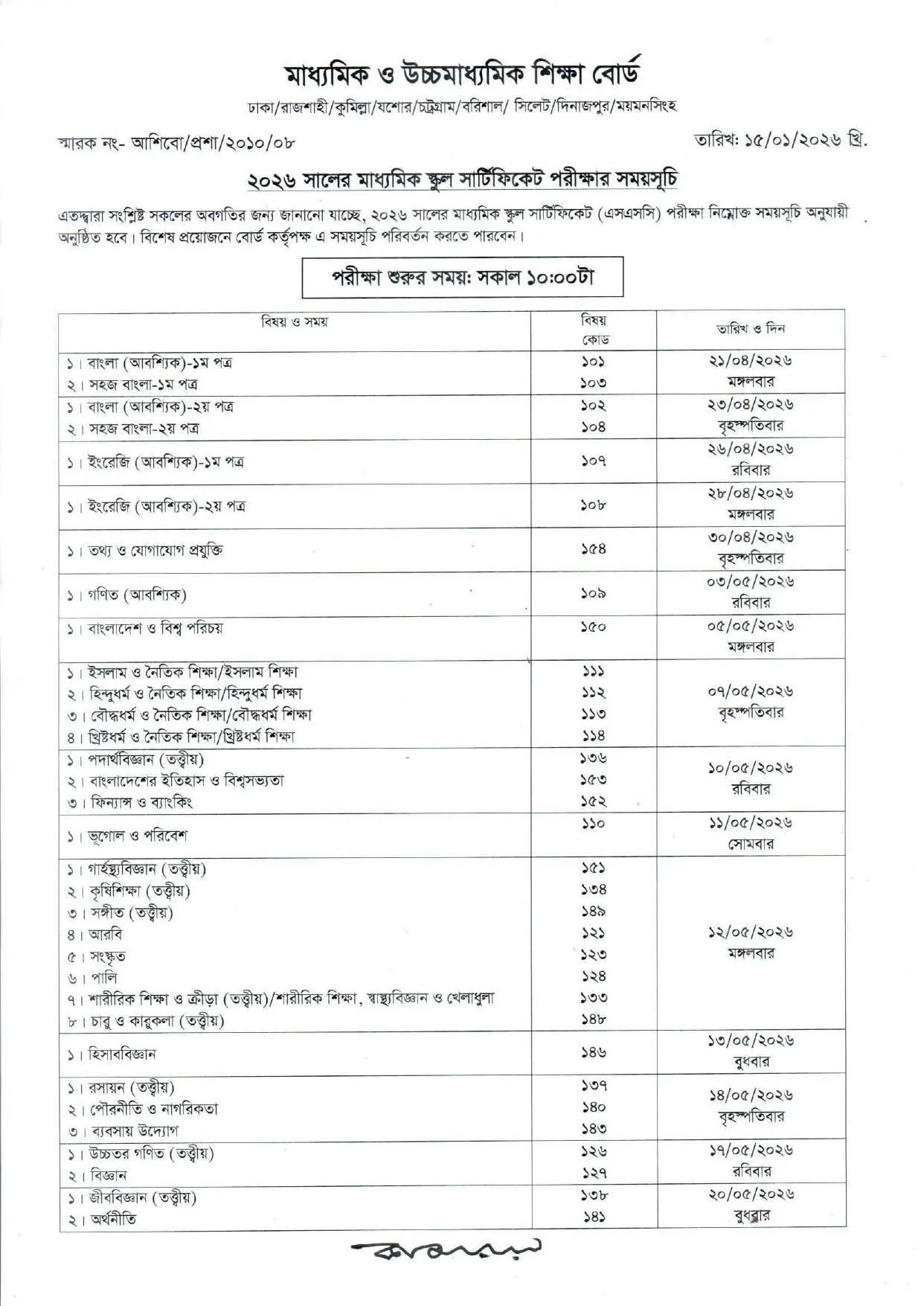
Below is the complete day-to-day SSC routine 2026 schedule. Mark these dates on your calendar immediately.
ssc routine 2026
| Date & Day | Subject & Code |
|---|---|
| 21/04/2026 (Tuesday) | Bangla (Compulsory) 1st Paper (101)Easy Bangla 1st Paper (103) |
| 23/04/2026 (Thursday) | Bangla (Compulsory) 2nd Paper (102)Easy Bangla 2nd Paper (104) |
| 26/04/2026 (Sunday) | English (Compulsory) 1st Paper (107) |
| 28/04/2026 (Tuesday) | English (Compulsory) 2nd Paper (108) |
| 30/04/2026 (Thursday) | Information & Communication Technology (ICT) (154) |
| 03/05/2026 (Sunday) | Mathematics (Compulsory) (109) |
| 05/05/2026 (Tuesday) | Bangladesh & Global Studies (150) |
| 07/05/2026 (Thursday) | Islam & Moral Education (111)Hindu Religion & Moral Education (112)Buddhist Religion & Moral Education (113)Christian Religion & Moral Education (114) |
| 10/05/2026 (Sunday) | Physics (136)History of Bangladesh & World Civilization (153)Finance & Banking (152) |
| 11/05/2026 (Monday) | Geography & Environment (110) |
| 12/05/2026 (Tuesday) | Home Science (151)Agriculture Studies (134)Music (149)Arabic (121) / Sanskrit (123) / Pali (124)Physical Education & Sports (133)Arts & Crafts (148) |
| 13/05/2026 (Wednesday) | Accounting (146) |
| 14/05/2026 (Thursday) | Chemistry (137)Civics & Citizenship (140)Business Entrepreneurship (143) |
| 17/05/2026 (Sunday) | Higher Mathematics (126)Science (127) |
| 20/05/2026 (Wednesday) | Biology (138)Economics (141) |
Note: All exams will start strictly at 10:00 AM. Ensure you are at the center well in advance.
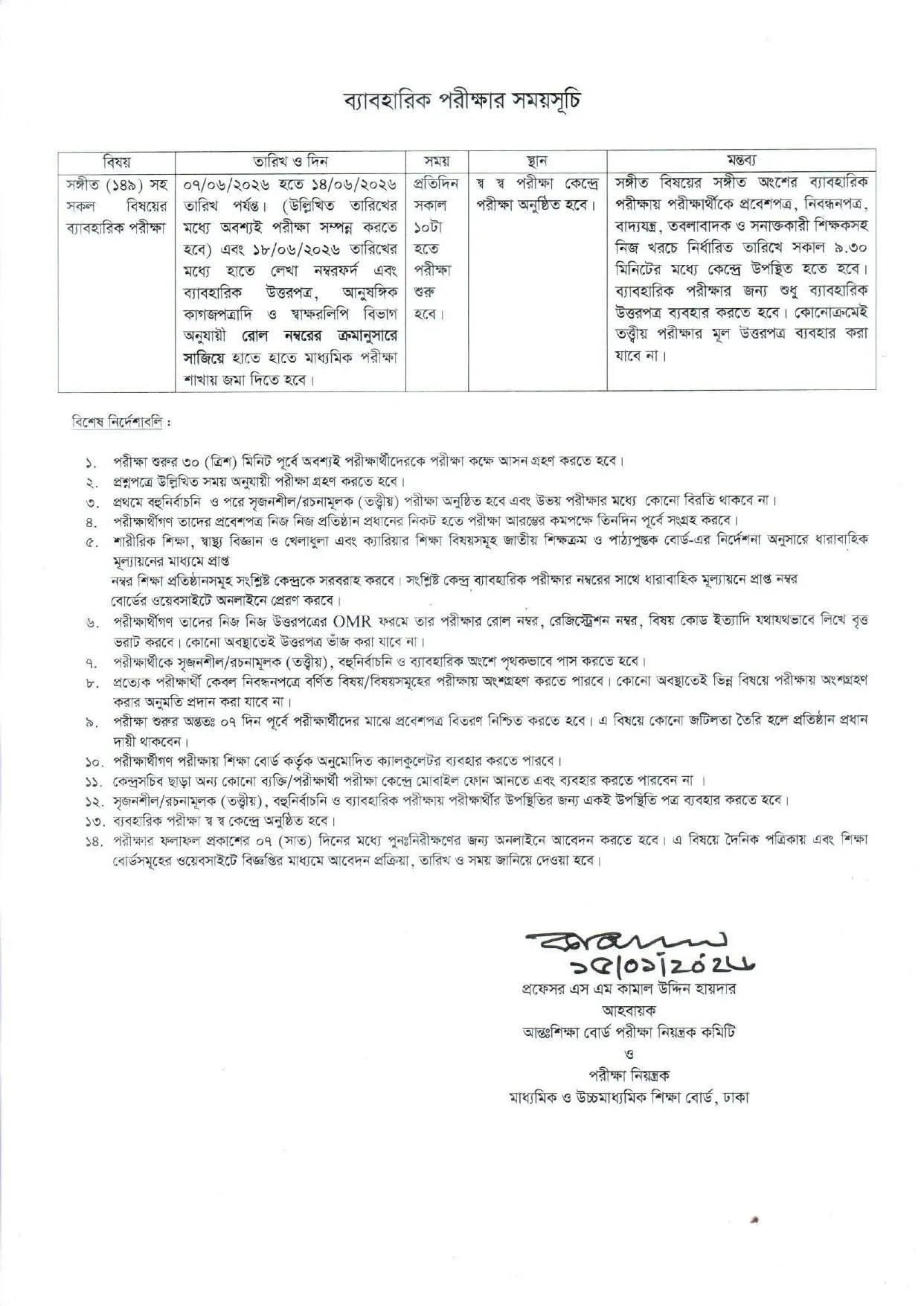
SSC Practical Exam Schedule 2026
The theory exams are only one part of the full examination process. They test your written knowledge, memory, and understanding. But for Science and Home Science students, the journey does not end there. The practical exams are just as important and carry significant marks. Ignoring them can cost you valuable points, even if your theory exam goes well.
Practical exams check how well you can apply what you have learned in real situations. They test your skills, accuracy, and confidence. Simple mistakes in experiments, records, or viva can reduce your marks. That is why Science and Home Science students must prepare for practicals with the same seriousness as theory papers. Regular practice, clear concepts, and neat presentation are the keys to securing full marks in practical examinations.
- Start Date: 07/06/2026 (Sunday)
- End Date: 14/06/2026 (Sunday)
- Venue: Your respective exam center (not your own school usually, but check the “Swaw Swaw” instruction, which often implies the designated center).
- Requirement: You must submit your practical notebook (Khata) signed by your teacher by June 18, 2026.
So, never keep your practical notebooks for the last moment. This is a very common mistake many students make. Writing practical records in a hurry increases errors and creates unnecessary stress. Teachers always advise finishing this work early, and there is a strong reason behind it.
Complete all your practical notebooks well before the theory exams start. Get them checked by your teachers and correct any mistakes in time. When April comes, your full attention should be on reading, revising, and practicing questions. If your practical work is already done, your mind will stay calm and focused. This simple habit can save time, reduce pressure, and help you perform better in both theory and practical exams.
How to Plan Your Study SSC Routine 2026
Now let us carefully look at the “holidays” or gaps between the major papers in the SSC Routine 2026. Many students think these gaps are for rest only, but in reality, this is where the exam game is truly decided. A student who uses these days wisely moves ahead. A student who wastes them falls behind.
These gap days are your best opportunity to revise important chapters, practice creative questions, and solve previous years’ papers. A short gap means quick revision. A long gap means deep study of weak areas. Teachers always say that smart use of holidays brings the best results. If you plan each gap day properly, you can improve your performance paper by paper. This is exactly where success is gained or lost.
1. The Bangla & English Gap
Use very simple planning here.
Between Bangla 1st paper and Bangla 2nd paper, you get only one day. That is very little time. So do not depend on this day for full preparation. Your Bangla 2nd paper, especially grammar and writing, must be ready before the exam starts.
The same rule applies to English. There is only a one-day gap between English 1st and 2nd papers. This day is not for learning new lessons. This day is only for quick revision. Read rules, formats, and common mistakes. Revise what you already know. Short gaps need smart revision, not fresh study.
2. The Math Challenge
Before the Mathematics exam, you get two full days—Friday and Saturday. This is a good amount of time if you use it properly. But remember one thing: Math cannot be prepared by reading only. It needs regular practice with pen and paper.
Keep a small formula sheet ready from before. Write all important formulas and rules there. On the first day, solve model tests and previous questions. Try to finish them within exam time. On the second day, check your mistakes. Revise difficult sums and important theorems. This simple two-day plan can increase your confidence and your marks.
3. The Science Group Pressure
The Science Group Pressure
Science students face extra pressure during the exam period. Physics is on Sunday, so you get two days after the Religion exam. This is helpful time, but only if you use it wisely. Revise formulas, practice numericals, and go through important chapters calmly.
Chemistry and Higher Math have fair gaps between exams. This gives you breathing space. Use these days to revise weak topics and solve test questions. Do not relax too much just because the gap is longer.
Be very careful with Biology. It is the last exam. Many students lose focus at the end. They feel tired and overconfident. This is a big mistake. Biology needs memory and clear revision. Stay disciplined until the final bell rings on May 20th. The exam ends that day, but your result depends on how serious you remain till the end.
Critical Rules & Guidelines for Students
The SSC Routine 2026 document also contains a section called “Special Instructions.” Many students skip this part. This is a big mistake. These rules are not optional. They are mandatory for every candidate.
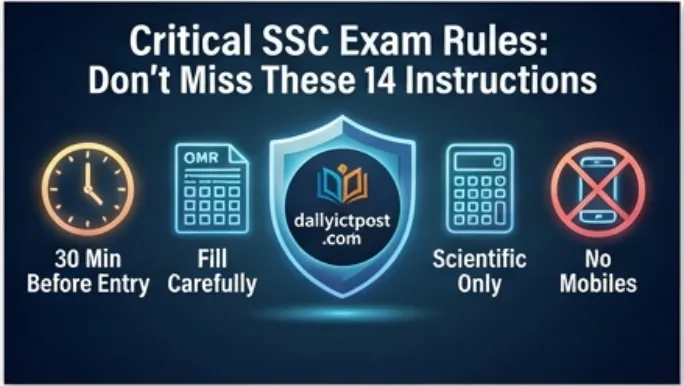
If you ignore these instructions, you may face serious problems in the exam hall. Your exam can be canceled. You may be marked absent. In some cases, future exams can also be affected. Teachers always warn students about this, but many still take it lightly.
To make things easy, I have simplified these rules for you. Below is a clear and student-friendly breakdown of the 14 most important instructions. Read them carefully. Remember them well. Following these rules is just as important as answering questions correctly.
- 30-Minute Rule: You MUST take your seat in the exam hall at least 30 minutes before the exam starts (i.e., by 9:30 AM). Traffic in cities like Dhaka can be unpredictable, so leave home early.
- Order of Answering: The Multiple Choice Questions (MCQ) exam happens first, followed immediately by the Creative/Written (CQ) part. There is no break between them.
- Admit Card Collection: You must collect your Admit Card from your school headmaster at least three days before the exam starts. Do not wait for the last day!
- OMR Sheet Caution: Fill in your Roll Number, Registration Number, and Subject Code carefully on the OMR sheet. A single mistake here can result in your result being withheld. Check the circles twice before darkening.
- Passing Rule: You must pass separately in the Creative (CQ), MCQ, and Practical parts. You cannot rely on just one section to save your grade.
- Calculator Policy: You can use a standard scientific calculator (non-programmable). Basic models like the Casio fx-991ES or fx-570MS are usually safe bets.
- No Mobiles Allowed: Only the Centre Secretary is allowed to have a mobile phone (and it can’t be a smartphone). Students are strictly prohibited from bringing phones, smartwatches, or Bluetooth devices.
For more details on exam hall etiquette, check out this guide on Exam Day Preparation Tips.
Subject-Wise Preparation Strategy
To crush the SSC Exam 2026, you need more than just hard work; you need a smart strategy.
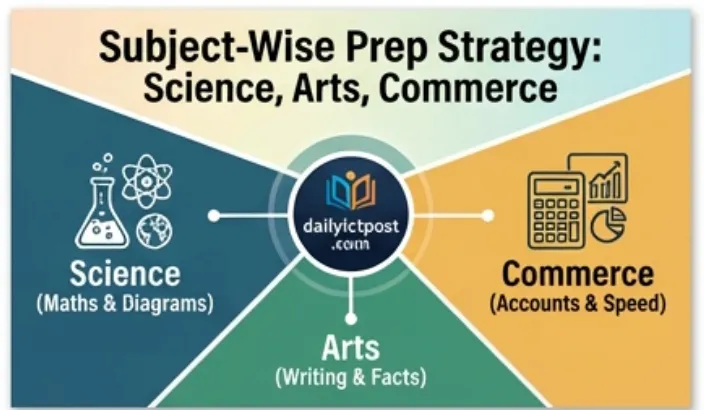
For Science Students
- Physics & Chemistry: Focus on mathematical problems and derivations. The creative questions often combine two different chapters.
- Higher Math: Practice geometry and trigonometry proofs.
- Biology: Diagrams are your best friend. A well-labeled diagram can fetch you full marks even if the description is brief.
For Arts & Commerce Students
- Accounting: Balance sheets must tally. Practice speed, as many students fail to finish the paper.
- General Science/Global Studies: Focus on the latest data and current affairs where applicable in your answers.
- English: Focus on the “Writing” part (Paragraphs, Letters). Avoid grammatical errors to impress the examiner.
You can find excellent resources and model tests at 10 Minute School or other educational platforms.
Mental Health & Final Days Preparation
The period between now and April 21st is stressful. It is normal to feel anxious.
Sleep: Ensure you get 6-7 hours of sleep. Your brain needs rest to store information.
Diet: Avoid heavy, oily street food. You cannot afford to get sick during the exam month.
Hydration: Drink plenty of water, especially since April and May can be very hot in Bangladesh.
If you are feeling overwhelmed, talk to your parents or a teacher. Remember, this exam is important, but your health comes first.
How to Download the SSC Exam Routine 2026
While I have provided the full schedule above, it is always good to keep the official PDF or image on your phone.
- Visit the official website of your education board (e.g., dhakaeducationboard.gov.bd).
- Go to the “SSC Corner” or “Notice Board” section.
- Look for the notice titled “SSC Exam Routine 2026”.
- Click download and save it.
Conclusion
The publication of the SSC Routine 2026 means the final stage has begun. This is the last lap of your long journey. You have studied and prepared for two full years for this moment. Every class, every note, and every test has led you here. Now is the time to stay serious and focused.
Use the remaining days wisely. Follow the routine strictly. Study according to the dates. Revise regularly and rest properly. Do not panic. Trust your preparation and believe in yourself. Remember, the routine is not just a list of exam dates. It is your clear roadmap to success and confidence.
Good luck to all SSC examinees of 2026. Stay calm, stay disciplined, and give your best in every exam. May your hard work bring you excellent results and a bright future ahead.
Please don’t forget to leave a review of my article.

![[PUBLISH NOW] Bangladesh Madrasah Education Board Job Circular 2026 – Apply Online](https://dailyictpost.com/wp-content/uploads/2026/02/PUBLISH-NOW-Bangladesh-Madrasah-Education-Board-Job-Circular-2026-–-Apply-Online-150x150.webp "[PUBLISH NOW] Bangladesh Madrasah Education Board Job Circular 2026 – Apply Online")




Comments are closed.