
We all hate that monthly text message from our mobile carrier saying, “Your bill is due,” or “Your data is running low.” It often feels like we are paying a premium price for services we don’t fully use, or worse, we are locked into rigid plans that don’t fit our actual lives. If you have ever felt like just a number to your big telecom provider, you are ready for a change. You are ready to understand the BTCL MVNO SIM. For many users, switching to an MVNO SIM is the easiest way to cut mobile costs without sacrificing coverage.
I remember the first time I heard the term. I was travelling and needed a cheap SIM card. A friend handed me one from a brand I had never heard of. “It uses the main network,” he said, “but costs half as much.” I was sceptical. How could it be cheaper and use the same towers? That scepticism led me down a rabbit hole of research, and what I found completely changed how I view mobile connectivity.
In this guide, I’m going to walk you through everything you need to know about the BTCL MVNO SIM, meaning, how it works, and why it is likely the smartest tech switch you will make this year. We will specifically look at the budding landscape of BTCL MVNO SIM in Bangladesh, helping you navigate this new terrain like a pro.
A BTCL MVNO SIM is a mobile SIM card that uses the same network towers as major operators but offers cheaper, flexible plans.
MVNOs don’t own towers—they buy network access in bulk and sell it at lower prices.
For users, it means the same coverage, lower cost, and no long-term contracts.

What is a BTCL MVNO SIM?
So, what is BTCL MVNO SIM exactly? Let’s strip away the corporate speak.
MVNO stands for Mobile Virtual Network Operator.
Think of the mobile industry like the airline industry. You have the major airlines that own the planes (these are the MNOs, or Mobile Network Operators—like Grameenphone or Robi). Then, you have travel agencies or charter companies that book seats on those same planes and sell them to you under a different package (these are the MVNOs).
When you use a Virtual mobile network operator SIM, you are essentially flying on the same plane (network) as everyone else, but you bought your ticket from a company that might offer better customer service, a cheaper meal, or a more flexible cancellation policy.
BTCL MVNO SIM Price in Bangladesh – Updated and User-Focused Guide
People searching for the BTCL MVNO SIM price in Bangladesh usually want one thing: clear and reliable information before buying. Most users are tired of confusing price lists and unofficial sellers giving mixed answers. This section explains the pricing in a simple and realistic way.
The price of a BTCL MVNO SIM in Bangladesh generally falls between BDT 100 and BDT 200. The exact amount can depend on where you purchase the SIM and whether any promotional offer is running at that time. In some cases, the SIM may include a small initial balance or bonus data.
What the SIM price usually covers:
- A prepaid BTCL MVNO SIM card
- Basic activation access to voice and data services
- Eligibility to purchase BTCL prepaid packages
The SIM price does not include monthly bundles or recharge plans. Users need to activate their preferred call or internet package separately after the SIM becomes active.
Many people choose BTCL MVNO because it is government-operated and follows strict telecom regulations. This creates trust among users who prefer stable pricing and transparent policies over aggressive marketing.
Before buying, it is always better to confirm the price from an authorized BTCL sales point. This helps avoid paying extra and ensures proper SIM registration.
For users looking for a low-cost and reliable mobile connection, BTCL MVNO SIM remains a practical option in Bangladesh.
BTCL SIM Buy Online Prepaid – How the Process Actually Works
The demand for BTCL SIM buy online prepaid options has increased as more users prefer digital services over visiting physical offices. Online SIM ordering is especially helpful for people living far from BTCL customer centers.
BTCL allows users to apply for prepaid SIMs online through official platforms or authorized partners. The process is straightforward and designed to reduce paperwork.
Steps to buy a BTCL prepaid SIM online:
- Visit an official BTCL or approved partner website
- Select the prepaid SIM option
- Enter your personal details carefully
- Upload a clear copy of your National ID
- Submit the application for verification
After submitting the request, the SIM may be delivered to your address or made available for collection. In many cases, biometric verification is required before final activation, as per government rules.
Online prepaid SIMs follow the same pricing and package structure as store-bought SIMs. There are no additional charges when using official channels.
Things to keep in mind:
- Avoid Facebook or unofficial sellers claiming instant activation
- Do not share NID information outside trusted platforms
- Always verify the website before submitting documents
Buying a BTCL prepaid SIM online saves time and reduces the risk of incorrect registration when done properly.
BTCL SIM Registration Check – How to Verify Ownership Safely
Many users look for BTCL SIM registration check methods to ensure their number is registered under their own identity. This is important because incorrectly registered SIMs can be suspended without notice.
BTCL provides several ways to check SIM registration status. The most common method is using USSD or SMS verification from the active BTCL number. In some cases, users may be redirected to an official verification system.
Common ways to check BTCL SIM registration:
- Use official USSD or SMS services
- Visit a nearby BTCL customer care center
- Contact BTCL customer support
- Use approved online verification tools
A proper registration check confirms whether the SIM is linked to your National ID. If any mismatch is found, users should correct it immediately through official channels.
Why SIM registration checking matters:
- Prevents unexpected SIM deactivation
- Ensures compliance with government regulations
- Protects against misuse or fraud
- Keeps services uninterrupted
BTCL follows strict SIM security guidelines. Users should never share NID details with unofficial agents offering quick fixes.
Regularly checking your BTCL SIM registration status ensures long-term service stability and peace of mind.
BTCL MVNO SIM Explained
Here is the simple truth: Building mobile towers is incredibly expensive. It costs billions to license the spectrum (the radio waves) and build the physical infrastructure.
A BTCL MVNO SIM provider bypasses this massive cost. They don’t build towers. Instead, they buy network capacity in bulk—huge wholesale chunks—from the big players who already have the towers. Then, they slice that capacity up and sell it to you and me.
Because they don’t have to worry about fixing broken antennas or paying for electricity at thousands of cell sites, their overhead is tiny. They pass those savings directly to you. That is the core of the MVNO SIM meaning: same network, smarter business model, lower price.
How BTCL MVNO SIM Works:
You might be worrying, “If they don’t own the network, is my connection going to be unstable?” It is a valid concern, but the answer lies in how BTCL MVNO SIM works.
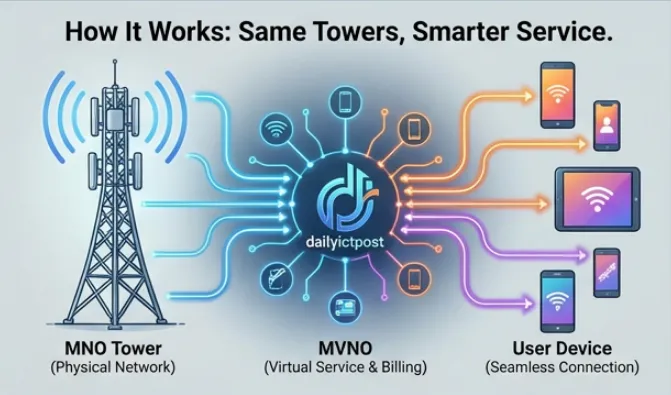
When you insert a BTCL MVNO SIM into your smartphone, here is the journey your data takes:
- Signal Handshake: Your phone searches for a signal. It finds a tower owned by a major MNO (let’s say Teletalk or Banglalink).
- Authentication: The tower sees your SIM card. Even though the card says “MyCoolMobile,” the tower recognises it as a valid guest because of the business agreement in the background.
- Connection: You are granted access. Your call or data travels through the MNO’s physical cables and towers.
- Service Handling: This is where the path splits. While the physical connection is the MNO’s responsibility, the service—your billing, your data balance check, your customer support—is routed to the MVNO’s servers.
This separation is seamless. You will likely see the MVNO’s name at the top of your screen, but your signal bars are powered by the big giants. This ensures that BTCL MVNO SIM coverage is rarely an issue. If the host network works in your bedroom, the MVNO will work there too.
MVNO vs MNO SIM:
To make the best choice, you need to weigh the MVNO vs MNO SIM differences side-by-side. It is not just about price; it is about priorities.
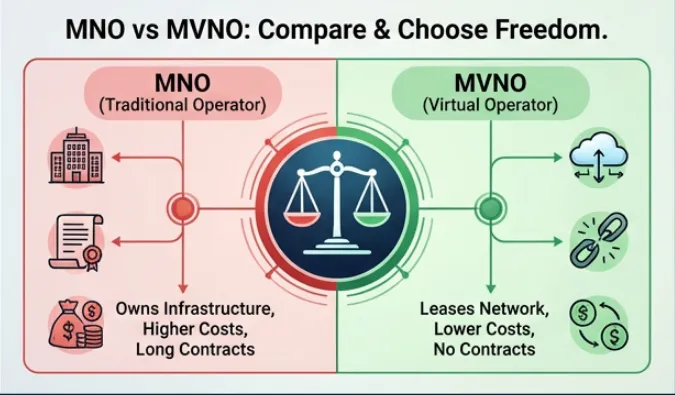
| Feature | MNO (Traditional Operator) | MVNO (Virtual Operator) |
|---|---|---|
| Ownership | Owns the towers, spectrum, and physical hardware. | Leases the network; owns the customer relationship. |
| Price Point | Usually higher. You pay for their brand and infrastructure maintenance. | Usually lower. You pay only for the service you use. |
| Contracts | Often requires 12-24 month contracts for the best rates. | Famous for “No-Contract” freedom. Pay month-to-month. |
| Customer Service | Huge call centres. Can be impersonal and slow. | Often app-based, digital-first, and highly responsive. |
| Perks | Free streaming subscriptions, movie tickets, loyalty points. | Simple, no-frills service. You get data and talk time, that’s it. |
| Priority | First in line. You get the fastest speeds during congestion. | Second in line. Speeds might dip slightly in very crowded areas. |
If you value VIP perks and being “first in line” at a crowded stadium, an MNO might be better. But if you value keeping cash in your wallet and hate being tied down, the MVNO SIM service is the clear winner.
BTCL MVNO SIM in Bangladesh:
Bangladesh is currently on the cusp of a telecom revolution. For years, we have had a few major players dominating the scene. But the landscape for BTCL MVNO SIM in Bangladesh is shifting rapidly due to new government policies.
The Role of Regulatory Change
The Bangladesh Telecommunication Regulatory Commission (BTRC) has recognised that more competition is good for the consumer. By issuing MVNO licenses, they are allowing local companies—ISPs, tech firms, and even large corporate brands—to launch their own mobile services.
What This Means for You
Imagine your internet service provider (ISP) offering you a SIM card that bundles your home Wi-Fi with your mobile data. Or imagine a ride-sharing app offering a SIM that gives you free data specifically for using their app. This is the potential of BTCL MVNO SIM in Bangladesh.
We are already seeing moves from state-owned entities like BTCL. Their “Alap” app was a precursor, a virtual service allowing cheap calls. The next logical step is a physical BTCL MVNO SIM that integrates these low-cost services directly into your phone without needing an internet connection to start the call. This would bring massive competition to the market, forcing traditional operators to lower their prices to compete.
For the latest updates on how technology is evolving in our region, keep an eye on trusted tech news sources like Daily ICT Post.
BTCL MVNO SIM Advantages and Disadvantages
I want to be completely transparent with you. While I am a huge fan of this model, it is not perfect for everyone. Let’s look at the MVNO SIM advantages and disadvantages in depth.
The Advantages
1. Massive Cost Savings
This is the headline feature. BTCL MVNO SIM, explained simply, is “discounted connectivity.” Because they run lean operations (no tower maintenance teams, fewer physical stores), they can undercut big carriers significantly. Families can save thousands of Taka per year by switching.
2. Consumer-Friendly Freedom
MNOs love to lock you in. They want you committed for years. BTCL MVNO SIM service providers are the opposite. They know they have to earn your business every month. If you don’t like them, you can leave next month with no penalty. This keeps them honest and keeps their service sharp.
3. Better Customer Support
Have you ever tried calling a major telecom helpline? You wait on hold for 20 minutes listening to elevator music. Many MVNOs operate primarily through slick, user-friendly apps. You can change your plan, top up, or chat with support instantly. It is a modern approach for modern users.
4. Niche Targeting
Big carriers have to appeal to everyone—from the CEO to the high schooler. MVNOs can specialise.
- For Travelers: Some offer SIMs with low-cost international calling as the standard, not an expensive add-on.
- For Students: High data, low talk time plans.
- For Seniors: Voice-only plans with simple billing.
The Disadvantages
1. Data Deprioritization
This is the biggest technical catch. In times of heavy network traffic—think New Year’s Eve or a cricket match stadium—the host MNO will prioritise its own direct customers. Your BTCL MVNO SIM data speeds might slow down temporarily. For 99% of the day, you won’t notice, but in a crunch, you might be second in line.
2. Lack of Handset Financing
Big carriers often subsidise the cost of the latest iPhone or Samsung Galaxy if you sign a contract. MVNOs generally don’t do this. You usually have to bring your own unlocked phone (BYOD – Bring Your Own Device).
3. Limited Retail Presence
If you are someone who likes to walk into a store and have a person set up your phone for you, you might struggle. Most MVNOs are digital-first. You order the SIM online, it arrives in the mail, and you activate it via an app.
BTCL MVNO SIM Coverage:
There is a persistent myth that Virtual mobile network operator SIM cards have worse signal strength. Let me be clear: This is false.
Your phone does not know the difference between an MVNO SIM and an MNO SIM when it comes to radio waves. It connects to the same tower.
- Urban Coverage: In cities like Dhaka or Chittagong, your experience will be indistinguishable from the major networks.
- Rural Reach: If the host MNO (e.g., Grameenphone or Robi) has a tower in a remote village, your MVNO SIM will work there.
- The “Roam” Indicator: Sometimes, your phone might show an “R” for roaming even when you are in your home city. This is just a technical quirk because your SIM (Guest) is roaming on the Host network. It doesn’t cost you extra.
Who Should Use a BTCL MVNO SIM Service?
Is this right for you? I have found that four types of people benefit the most from how MVNO SIM works.
1. The Budget-Conscious Student
You live on WhatsApp and YouTube. You rarely make traditional voice calls. Why pay for a bundle that includes 500 SMS and 300 voice minutes you will never use? MVNOs allow you to pick data-heavy plans that fit a student budget perfectly.
2. The Expat or International Caller
If you have family abroad, traditional international calling rates are a nightmare. Many ethnic-focused MVNOs (like Lycamobile globally) built their entire business on offering cheap international calls.
3. The Light User
My grandmother uses her phone for emergencies and the occasional call to me. She doesn’t need 4G data or unlimited streaming. Big carriers often ignore low-usage customers. MVNOs often have “Pay As You Go” plans where credit never expires, perfect for light users.
4. The Second SIM User
With most modern phones supporting Dual SIM, many people use a primary MNO SIM for voice and a secondary MVNO SIM purely for cheap data. It is a “best of both worlds” strategy.
Future Trends: Where is the BTCL MVNO SIM Going?
The technology isn’t standing still. The future of MVNO SIM is expanding beyond just phones.
- IoT (Internet of Things): We are seeing MVNOs launch specifically for smart devices—connecting your car, your smart meter, or your agricultural sensors.
- eSIM Adoption: The physical plastic card is dying. Soon, you will be able to switch to an MVNO instantly by scanning a QR code, making it even easier to test out a service without waiting for mail delivery.
- 5G Customisation: With 5G, networks can be “sliced.” An MVNO could technically buy a “slice” of the network dedicated purely to low-latency gaming, offering a “Gamer SIM” that guarantees no lag.
If you’re still unsure whether a BTCL MVNO SIM is right for you, these are the most common questions people ask before switching.
FAQ about BTCL MVNO SIM
1. Is a BTCL MVNO SIM legal in Bangladesh?
Yes, absolutely. The government has formalised the licensing process, making BTCL MVNO SIM in Bangladesh a fully regulated and legal industry.
2. Can I keep my number if I switch to a BTCL MVNO?
Yes. Mobile Number Portability (MNP) rules apply to MVNOs too. You can port your existing number to a BTCL MVNO SIM service without losing your contacts.
3. Why is it called a “Virtual” operator?
It is “virtual” because they don’t have a physical radio network of their own. They exist virtually on someone else’s physical hardware.
4. Will my internet speed be slower?
In general, no. However, during peak congestion, you might experience “throttling” or prioritization where your speed drops slightly compared to MNO customers.
5. How do I know which network an MVNO uses?
Most MVNOs are transparent about this because they want you to know they have good coverage. For example, they might say “Powered by the Robi Network.”
6. Do I need a special phone for a BTCL MVNO SIM?
No. Any unlocked GSM phone will work. If your phone is locked to a specific carrier (common in the US/Europe, less so in Bangladesh), you might need to unlock it first.
7. Are there hidden fees with the BTCL MVNO SIMs?
Rarely. One of the main BTCL MVNO SIM advantages is transparency. Since most plans are prepaid, you can’t accidentally run up a huge bill.
8. Can I use 5G with an MVNO?
Yes, if the host MNO offers 5G and the MVNO has signed an agreement for 5G access.
9. Is customer service really better?
It is often more accessible. Instead of visiting a crowded store, you can usually solve issues via in-app chat or social media support, which is faster for digital natives.
10. What happens if the MVNO goes out of business?
Regulations usually require MVNOs to have a contingency plan. In the worst case, you would simply port your number back to a main MNO or another provider.
Conclusion
The telecommunications world is changing. We are moving away from the era of “one size fits all” giants and into an era of personalised, flexible, and affordable connectivity. The BTCL MVNO SIM is at the forefront of this shift.
By understanding what an MVNO SIM is and evaluating the BTCL MVNO SIM advantages and disadvantages, you are empowering yourself. You are no longer just a passive bill-payer; you are an active chooser of the service that fits your life.
Whether you are waiting for the latest BTCL MVNO SIM in Bangladesh to launch or looking for a travel SIM for your next trip, remember that the “virtual” operator offers very “real” benefits. Lower costs, better service, and the freedom to switch when you want—that is a power worth having in your pocket.
এই পোস্টটি ভাল লেগে থাকলে রিভিউ দিতে ভুলবেন না।