
Preparing for your SNAP interview questions USA 2026 can feel like a big unknown. But with the right information, you can walk into that conversation with real confidence and walk out with the food assistance you need.
The Supplemental Nutrition Assistance Program (SNAP) helps millions of Americans buy groceries every month. But before you get benefits, you must complete an eligibility interview. This guide walks you through the SNAP interview questions and answers USA. You will learn what to expect, how to prepare, and the helpful tips to avoid common mistakes.
Think of this interview as a routine check-in. The caseworker just wants to verify your application details. They are not trying to trap you. By the end of this guide, you will feel ready to answer any question that comes your way.
Quick Answer: SNAP Interview Questions USA 2026
- Identity- Name, DOB, SSN, address
- Household- Who lives with you & eats together
- Income- Job, benefits, total monthly income
- Expenses- Rent, utilities, medical costs
- Assets- Bank accounts, vehicles
Interview usually lasts 20–30 minutes and is required for approval.
SNAP Interview Pass Checklist:
- Documents ready
- Income calculated
- Household clear
- Expenses listed
- Phone ready
At-a-Glance Summary:
- Interview takes 20–30 minutes
- Questions about income, household, expenses
- Documents required
- Approval within 7–30 days
Table of Contents
ToggleWhat Exactly Is a SNAP Interview? (Your First Step to Food Assistance)
The SNAP eligibility interview is a required part of the application process. After you submit your application, a caseworker contacts you to schedule this interview. It can happen in person at a local office or over the phone.
The main goal is simple. The caseworker reviews your application to make sure everything is correct and complete. They want to verify your household situation, income, and expenses. This helps them decide if you qualify and how much you should receive.
Based on USDA SNAP guidelines, the interview is a required step to verify eligibility. It makes sure eligible households get the right benefit amount. Do not skip this step. If you miss your interview, your application could be denied. Most states require you to complete the interview within 30 days of applying.
Read more: Why Did My Benefits Stop? Understanding the SNAP Case Closed Reason USA 2026
2. SNAP Phone Interview Questions Explained: What Happens Over the Call?
Many applicants finish their interview over the phone. This saves time and makes the process easier. The SNAP phone interview questions are almost identical to those asked in person.
During the call, the caseworker asks you to confirm basic personal details. They ask about your household members, income sources, and monthly expenses. Be ready to answer questions about your rent, utilities, and any medical costs if you are elderly or disabled.
A typical phone interview lasts about 20 to 30 minutes. The caseworker guides you through each section. They may ask you to provide document numbers or read information from your pay stubs. Stay calm and answer honestly. You can ask them to repeat a question if you do not understand it.
See more: Do You Qualify for SNAP in 2026? SNAP Income Limit for Single Person USA 2026 | Best Explanation
How This Guide Was Created
This guide is based on:
- USDA SNAP interview guidelines
- State-level application processes
- Real applicant experiences
- Updated 2026 eligibility requirements
Our goal is to provide accurate and practical preparation advice.
3. SNAP Interview Questions USA 2026? (Full Question List)
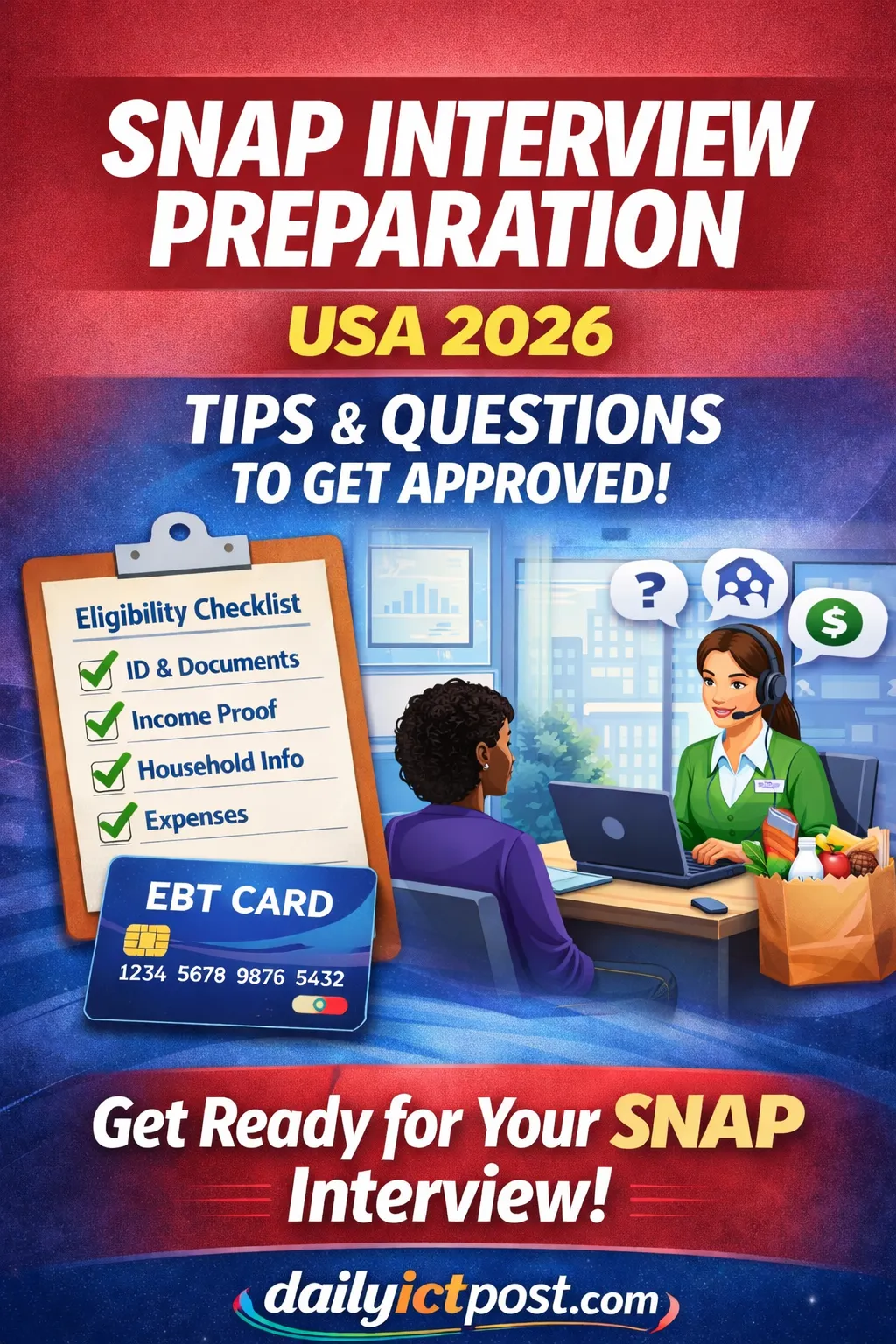
Are you wondering about the exact SNAP Interview Questions USA 2026? Here is a detailed breakdown of what do they ask in a SNAP interview 2026. These questions fall into several clear categories.
Personal Identification Questions:
What is your full legal name and date of birth?
What is your Social Security number?
What is your current mailing and physical address?
Are you a U.S. citizen or a qualified non-citizen?
Household Composition Questions:
Who lives with you in your home?
What are the names and dates of birth of all household members?
Do you purchase and prepare meals together with these individuals?
Does anyone else claim anyone in your home as a dependent on their taxes?
Income Verification Questions:
What is your total monthly income from all sources?
Do you receive wages, self-employment income, or tips?
Do you receive Social Security, disability, or unemployment benefits?
Do you receive child support or alimony payments?
Expense and Deduction Questions:
How much do you pay for rent or your mortgage each month?
Do you pay for utilities like electricity, heating, or water?
Do you have dependent care costs for children or disabled adults?
Do you have out-of-pocket medical expenses over $35 per month?
Asset and Resource Questions:
Do you have any money in bank accounts or retirement funds?
Do you own any vehicles, property, or other valuable assets?
Do you have any money set aside for a specific purpose?
Learn more: SNAP Benefits for Family Per Person Monthly USA 2026: Best Family Guide Ever
4. Food Stamp Interview Questions List USA
Let us look at the food / SNAP Interview Questions USA 2026 in a more organized way. Here is a table that groups questions by category for easy reference.
| Question Category | Example Questions | Why They Ask |
|---|---|---|
| Identity & Residency | “Can you confirm your full name and address?” | To verify you are who you say you are |
| Household Members | “Who else lives with you and shares meals?” | To determine your household size |
| Earned Income | “How much do you earn from your job each month?” | To calculate your gross monthly income |
| Unearned Income | “Do you receive Social Security or child support?” | To include all money coming into the home |
| Housing Expenses | “How much is your monthly rent or mortgage?” | To apply shelter deductions |
| Utility Costs | “Do you pay for heating, electricity, or water?” | To apply standard or actual utility deductions |
| Medical Expenses | “Do you have medical bills over $35 per month?” | To help elderly and disabled applicants |
| Child/Dependent Care | “Do you pay for childcare while you work?” | To deduct work-related expenses |
| Asset Verification | “Do you have money in checking or savings accounts?” | To check if you meet asset limits |
| Immigration Status | “What is your immigration status?” | To verify eligibility for non-citizens |
5. EBT Interview Process Questions USA: What You Must Know
The EBT interview process questions USA focus heavily on your financial situation. The caseworker wants to ensure you truly need assistance. After your interview and approval, you will receive an EBT (Electronic Benefits Transfer) card. This card works like a debit card for buying food.
During the interview, expect detailed questions about your income and expenses. The caseworker will verify that you meet the income limits for your household size. They will also explain how to use your EBT card properly. You cannot use your card to buy alcohol, tobacco, hot prepared foods, or non-food items.
State guidelines require a single interview to cover all programs you are applying for. If you are also applying for cash assistance or Medicaid, those questions will be included too. Just be patient and answer each question carefully.
Important: Missing Your Interview Can Lead to Denial
- Missing your SNAP interview may result in application denial
- Delays can extend approval time
- Rescheduling late can restart the process
Always attend or reschedule immediately.
6. SNAP Eligibility Interview Questions 2026: How to Prove Your Need
The SNAP eligibility interview questions 2026 are designed to assess your financial need. The caseworker compares your answers against federal and state guidelines. Each state has slightly different income limits and deduction rules.
Here are the key eligibility factors they evaluate.
Gross Monthly Income: This is your total income before any taxes or deductions. For most households, your gross income must be at or below 130% of the federal poverty level.
Net Monthly Income: After subtracting allowed deductions, your net income must be at or below 100% of the federal poverty level. Deductions include a standard deduction, earned income deduction, dependent care deduction, medical expenses for elderly or disabled, and shelter costs.
Household Size: Your household includes everyone who lives together and buys food together. Larger households have higher income limits.
Work Requirements: Able-bodied adults without dependents (ABAWDs) must work or participate in a work program for at least 80 hours per month. Some states have waivers for this rule.
Asset Limits: Most states have asset limits, but many have raised or removed these limits in recent years.
Related: SNAP Income Limit Checker 2026: Check If You Qualify (Avoid Costly Mistakes)
7. The Exact Documents Needed for SNAP Interview (Checklist Inside)
Having the right paperwork makes your interview smooth and fast. Here is the complete list of documents needed for SNAP interview.
Proof of Identity (choose one):
Driver‘s license or state ID card
Birth certificate
U.S. passport or passport card
Work visa or resident alien card (green card)
School ID with photo (for students)
Proof of Social Security Numbers:
Social Security cards for all household members
Official documents showing SSNs for everyone applying
Proof of Residency (choose one):
Recent utility bill (electric, gas, water, or trash)
Lease agreement or rental receipt
Mortgage statement or property tax bill
Official government mail with your address
Proof of Income (last 30-60 days):
Pay stubs from all jobs
Employer letter verifying wages and hours
Social Security award letter
Unemployment benefit statement
Pension or retirement distribution statement
Child support payment records
Self-employment income and expense logs
Proof of Expenses:
Rent receipt or lease agreement
Mortgage statement
Utility bills (heating, electricity, water, phone)
Childcare receipts or provider statement
Medical bills and prescription receipts (for elderly or disabled)
Court-ordered child support payments
Proof of Citizenship or Immigration Status (if applicable):
U.S. passport or birth certificate
Naturalization certificate
Green card (Permanent Resident Card)
Work authorization document (EAD)
Refugee or asylee documentation
Continue Reading: How to Increase Monthly SNAP Payment 2026 (Powerful Legal Tricks Most People Miss)
8. SNAP Interview Tips to Get Approved Fast (Proven Strategies)
Success in your interview comes down to preparation. Follow these SNAP interview tips to get approved fast.
Tip #1: Gather All Documents Before the Call
Spread your paperwork out on a table before the interview starts. Organize them by category: identity, income, expenses, and household information. This way, you can quickly find any document the caseworker asks for.
Tip #2: Answer Questions Honestly and Directly
Do not exaggerate your expenses or hide your income. The caseworker has access to various databases that can verify your information. Honesty builds trust and speeds up approval.
Tip #3: Ask Questions If You Are Unsure
If you do not understand a question, say so. Ask the caseworker to explain what they need. You can also ask them to repeat the question. It is better to ask for clarification than to give a wrong answer.
Tip #4: Be Specific About Your Numbers
Instead of saying “about $500” for your rent, say the exact amount you pay each month. Use specific dollar figures for your income and expenses. This reduces confusion and shows you are organized.
Tip #5: Mention All Your Expenses
Many applicants forget small but important expenses. Tell the caseworker about your phone bill, internet costs, and any medical co-pays. These expenses might be deductible and could increase your benefit amount.
Tip #6: Stay Calm and Speak Clearly
Take a deep breath before the interview. Speak slowly and clearly, especially during a phone interview. If you feel nervous, pause for a moment. The caseworker understands that interviews can be stressful.
Tip #7: Write Down Key Information Beforehand
Create a cheat sheet with your monthly income, rent, utility costs, and other important numbers. Keep this sheet in front of you during the interview. This prevents you from forgetting details under pressure.
What Happens After SNAP Interview
- Approved → benefits within 7–30 days
- Pending → document request
- Denied → appeal option
9. Common SNAP Interview Mistakes to Avoid (Don’t Let These Happen to You)
Even well-intentioned applicants make mistakes. Here are the common SNAP interview mistakes to avoid.
Mistake #1: Missing Your Scheduled Interview
This is the most common and costly mistake. If you miss your interview, your application may be denied. Write down the date and time immediately. Set multiple reminders on your phone. If you cannot make it, call to reschedule as soon as possible.
Mistake #2: Providing Incomplete or Incorrect Information
Giving wrong information, even by accident, can delay your application. Double-check all numbers before you share them. Review your application beforehand to ensure your answers match what you wrote.
Mistake #3: Failing to Report All Household Members
Some applicants try to exclude certain household members thinking it will increase their benefits. This is fraud and can lead to serious penalties. Always report everyone who lives with you and shares meals.
Mistake #4: Not Having Documents Ready
Searching for papers while the caseworker waits creates frustration. It also makes you appear unprepared. Have all your documents organized and within reach before the interview starts.
Mistake #5: Guessing Instead of Saying “I Don’t Know”
Do not guess if you are unsure about an answer. It is perfectly fine to say, “I don‘t know, but I can find that information for you.” Then provide the correct information as soon as possible.
Mistake #6: Forgetting to Report Changes
Your situation may change between the time you apply and your interview. Report any changes in income, household size, or expenses immediately. Failure to report changes can result in an overpayment that you must pay back.
Mistake #7: Getting Frustrated or Argumentative
Caseworkers follow strict federal and state rules. They cannot bend the rules for you. Stay polite and professional, even if you disagree with a question or decision. Kindness goes a long way.
10. SNAP Recertification Interview Questions USA: Renewing Your Benefits
Your SNAP benefits do not last forever. You must go through recertification periodically to keep receiving assistance. The SNAP recertification interview questions USA are very similar to your initial interview questions.
Recertification typically happens every 6 to 12 months. Your state will send you a notice about 30 to 45 days before your certification period ends. You must complete the recertification process before your benefits expire.
USDA rules say states must do interviews at initial certification and at least once every 12 months after that for recertification. This interview makes sure you still meet the eligibility requirements.
During recertification, the caseworker asks about any changes in your household since your last interview. They verify your current income, expenses, and household composition. If nothing has changed, the process is usually quick and easy.
Many states let you complete recertification over the phone. Some even offer online recertification without an interview. Check with your local SNAP office to know your options.
11. How to Prepare for Your SNAP Interview: A Step-by-Step Plan
Preparation reduces anxiety and increases your chances of approval. Follow this step-by-step plan.
Step 1: Review Your Application
Read through your completed SNAP application carefully. Make sure you remember every answer you provided. The caseworker will compare your verbal answers to your written application.
Step 2: Gather All Required Documents
Use the document checklist provided earlier in this guide. Collect every paper you might need. Place them in a folder or envelope for easy access.
Step 3: Calculate Your Monthly Numbers
Add up your total monthly income from all sources. Calculate your rent, utilities, and other major expenses. Write these numbers down on a single sheet of paper.
Step 4: Practice Answering Questions
Ask a friend or family member to role-play the interview with you. Have them ask you the common questions listed in this guide. Practice until you feel comfortable.
Step 5: Prepare Your Environment (For Phone Interviews)
Find a quiet room with no background noise. Turn off the TV and ask others to be quiet. Make sure your phone has good reception and a full battery.
Step 6: Write Down Questions for the Caseworker
You have the right to ask questions too. Write down anything you want to know about the program, your benefits, or the application process.
Step 7: Stay Positive and Confident
Remember, the caseworker wants to help you. Go into the interview with a positive mindset. Believe that you deserve the assistance you are seeking.
12. What Happens After Your SNAP Interview? (The Timeline)
After you finish your interview, the caseworker reviews all your information. They may request additional documents if something is missing. The typical timeline looks like this.
Within 7 days: The caseworker determines if you qualify for expedited benefits. Households with little or no income may receive benefits within 7 days.
Within 30 days: Most households receive a decision within 30 days of applying. This includes the interview and document verification.
If approved: You receive an approval letter and your EBT card in the mail. Your benefits are loaded onto the card each month.
If denied: You receive a denial letter explaining why. You have the right to appeal the decision within a certain timeframe.
If the caseworker needs more information, they will send you a notice. You typically have 10 days to provide the missing documents. Failure to respond can lead to a denial.
13. Real-Life Success Stories: How Preparation Led to Approval
Many applicants worry unnecessarily about their interviews. Let us look at two real-life examples.
Maria‘s Story:
Maria, a single mother of two, lost her job during a company downsizing. She applied for SNAP and felt terrified about the phone interview. Using this guide, she gathered all her documents and practiced her answers. During the interview, she answered every question confidently. The caseworker approved within a few days after submitting documents. Maria received $456 per month in benefits to feed her children.
James’s Story:
James is a 67-year-old retiree living on a small Social Security check. He worried that his income might be too high for SNAP. During his interview, he mentioned his $150 per month in medical expenses. The caseworker deducted those expenses from his income. James qualified for $95 per month in benefits, which helped him afford fresh produce and lean proteins.
These stories show that preparation and honesty pay off. You can be a success story too.
14. The Pros and Cons of the SNAP Interview Process
Knowing both the good and the bad sides of the interview process helps you manage expectations.
| Pros of the SNAP Interview | Cons of the SNAP Interview |
|---|---|
| Ensures benefits go to truly eligible households | Can be stressful for nervous applicants |
| Allows you to ask questions about the program | Requires time off work for in-person interviews |
| Gives you a chance to explain special circumstances | Phone reception issues can cause problems |
| Helps caseworkers spot missing information early | Language barriers can create confusion |
| Provides an opportunity to appeal denials in person | Wait times for scheduling can be long |
| Creates a personal connection with your caseworker | Some caseworkers may seem unfriendly |
| Allows for expedited processing in emergencies | Missed interviews lead to automatic denials |
| Verifies your identity to prevent fraud | Document requirements can feel overwhelming |
15. SNAP Interview Questions and Answers USA: Sample
Here are SNAP interview questions and answers USA with sample responses you can adapt.
Q: Can you confirm everyone who lives in your household?
A: “Yes. I live with my spouse and our two children, ages 4 and 7. We all purchase and prepare our meals together. No one else lives in our home.”
Q: What is your total monthly income from all sources?
A: “I work 30 hours per week at a retail store. My gross monthly income is $1,800. My spouse receives $500 per month in Social Security disability benefits. Our total household income is $2,300 per month.”
Q: Do you pay for housing or utilities?
A: “Yes. Our rent is $900 per month. We pay $120 for electricity, $50 for water, and $80 for gas heating. I have all my utility bills here if you need to see them.”
Q: Do you have any medical expenses?
A: “My spouse has diabetes and high blood pressure. We spend about $75 per month on prescription medications and doctor co-pays. I can provide pharmacy receipts.”
Q: Has anyone in your household applied for SNAP benefits before?
A: “No, this is our first time applying for SNAP. We recently experienced a job loss and are seeking temporary assistance.”
16. What Answers Can Increase Your SNAP Benefits? (Insider Tips)
- Mentioning all deductions
- Reporting medical expenses
- Including childcare costs
17. Why SNAP Interviews Get Denied (Real Reasons)
- Inconsistent answers
- Missing documents
- Wrong household info
18. Important: SNAP Interview Rules Vary by State
- Some states skip interviews
- Some require in-person
- Some allow online
19. Answers That Can Delay or Risk Your Approval
- “I’m not sure about my income”
- “I forgot household members”
20. Frequently Asked Questions About the SNAP Interview
Q: How long does a SNAP interview usually take?
A: Most interviews last between 20 to 30 minutes. Complex cases with many household members or income sources may take up to 45 minutes.
Q: Can I reschedule my SNAP interview if I cannot make it?
A: Yes, you can reschedule. Call the SNAP office as soon as possible to request a new date. Do not simply miss the interview without calling.
Q: What happens if I do not understand a question during the interview?
A: Ask the caseworker to repeat or explain the question. It is always better to ask than to guess incorrectly.
Q: Can I bring someone with me to an in-person SNAP interview?
A: Yes, you are allowed to bring a friend, family member, or advocate for support. Some states allow you to designate an authorized representative to handle the interview for you.
Q: Will my SNAP interview affect my immigration status?
A: No. Information shared during the SNAP interview is used only for determining benefit eligibility. It is not shared with immigration enforcement agencies.
Q: What if I am homeless? Can I still complete the SNAP interview?
A: Yes. Homeless individuals can qualify for SNAP. The caseworker will help you find a way to complete the interview and receive your EBT card.
Q: Do I need to speak English during the interview?
A: No. SNAP offices provide interpreter services for non-English speakers. You can request an interpreter when you schedule your interview.
Q: How will I know if my SNAP application is approved?
A: You will receive an official letter from your state SNAP office. The letter will explain your benefit amount and certification period.
Q: Can my SNAP benefits be taken away after the interview?
A: Your benefits continue as long as you remain eligible. You must report changes in your situation and complete recertification on time.
Q: What if I disagree with the caseworker’s decision?
A: You have the right to appeal. Your denial letter will explain how to request a fair hearing. An impartial hearing officer will review your case.
Conclusion:
The SNAP interview questions USA 2026 do not need to be scary. With proper preparation, honesty, and confidence, you can handle this process successfully. Remember that the caseworker is there to help you access the food assistance you deserve.
Gather your documents ahead of time. Practice answering common questions. Stay calm and speak clearly. Report all your income and expenses accurately. Avoid the common mistakes that delay approvals. Most importantly, believe in yourself and your right to receive help during tough times.
SNAP exists to keep American families fed. Do not let fear of an interview stop you from applying. Use this guide, follow the tips, and take that important step toward food security. You have got this.
CTA Message: Need More Help with Your SNAP Interview? Download Our Free SNAP Interview Preparation Checklist and Get Approved Faster – Click Here Now!
Editorial Disclaimer
This article is for informational purposes only and does not represent any government agency.
SNAP rules, eligibility criteria, and interview processes may vary by state and can change over time. Always verify information through your local SNAP office or official government sources.
We do not guarantee benefit approval.
For official guidance, contact your state SNAP agency.
Author

The dailyictpost.com team presents job recruitment notices, various government and private job question solutions, government post activities and technology-based information in simple and practical language. Along with this, we explain ICT, mobile, computer, apps, online income, digital tools, government services, national elections and cyber security-related issues in such a way that the reader can understand and learn.
We believe that learning technology is not difficult, if it is explained correctly. Therefore, we present complex topics like using new software, mobile settings or digital marketing step by step in such a language that it feels like someone is sitting next to you and explaining it in a simple way.
Our goal is only one - that the reader gets accurate information, learns with confidence and can use that knowledge in real life.