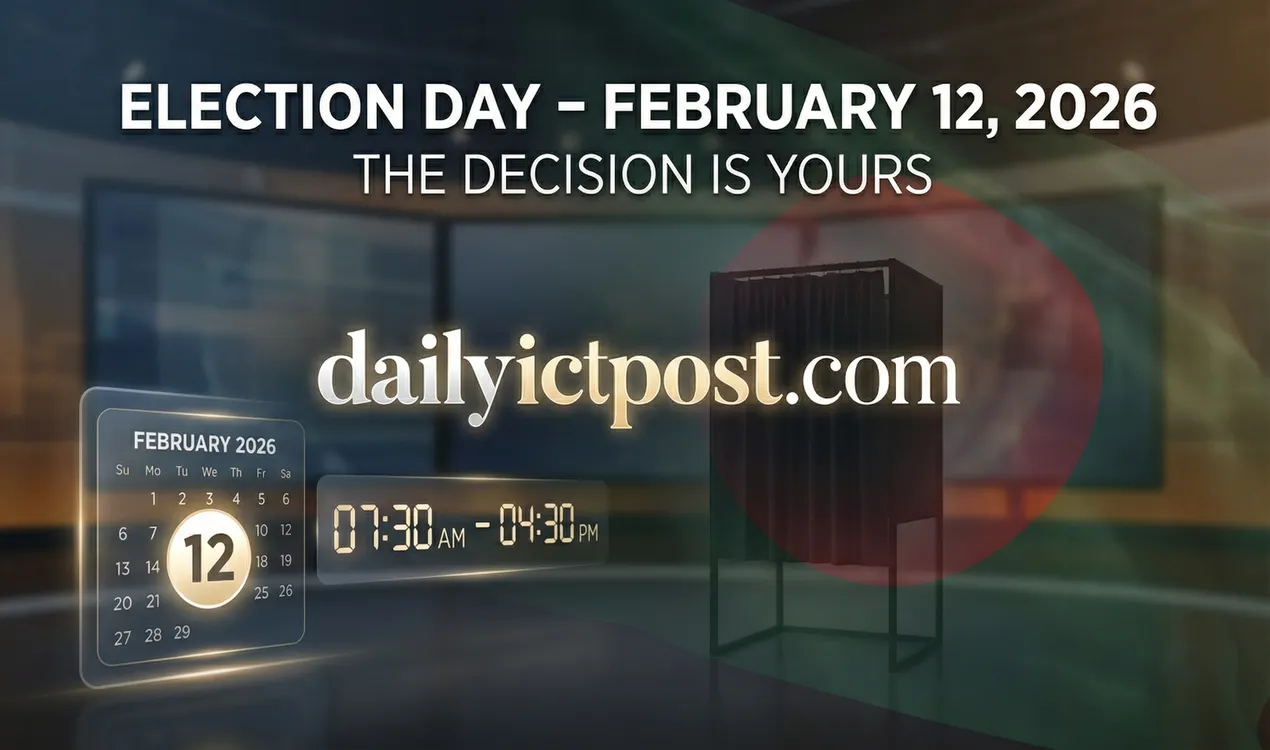
The wait is finally over. After eighteen months of interim governance and a complete overhaul of the political landscape, the 13th Parliamentary Election is here. Tomorrow, February 12, 2026, marks a pivotal moment for the nation. For the first time in nearly two decades, we are looking at a fiercely competitive election, but the players have changed. With the Awami League no longer in the running, the old “Boat vs. Sheaf of Paddy” rivalry has been replaced by a new.
In this detailed Bangladesh election 2026 prediction, we’ll break down the real situation between the Bangladesh Nationalist Party and Bangladesh Jamaat-e-Islami.
The political heat is rising. Streets are buzzing. Social media is louder than ever. As the country heads into the 13th parliamentary vote, one question keeps coming back:
Who is really ahead?
This is not about hype. It’s about patterns, voter mood, and political math. Think of it like reading the weather before a storm. You don’t guess. You watch the wind, the clouds, and the air pressure.
This isn’t just another vote; it feels like a referendum on the future direction of the country. Everyone is asking the same question: Who will win the Bangladesh election 2026, BNP or Jamaat? Let’s dive into the ground reality, the data, and the sentiments driving this historic election to see where the wind is blowing.
Bangladesh Election 2026 – Quick Insight
Voting Date: February 12, 2026
Election Type: 13th National Parliamentary Election
Key Political Forces: BNP, Jamaat-led alliance, smaller coalition groups
Major Deciding Factors: Voter turnout, youth participation, alliance coordination
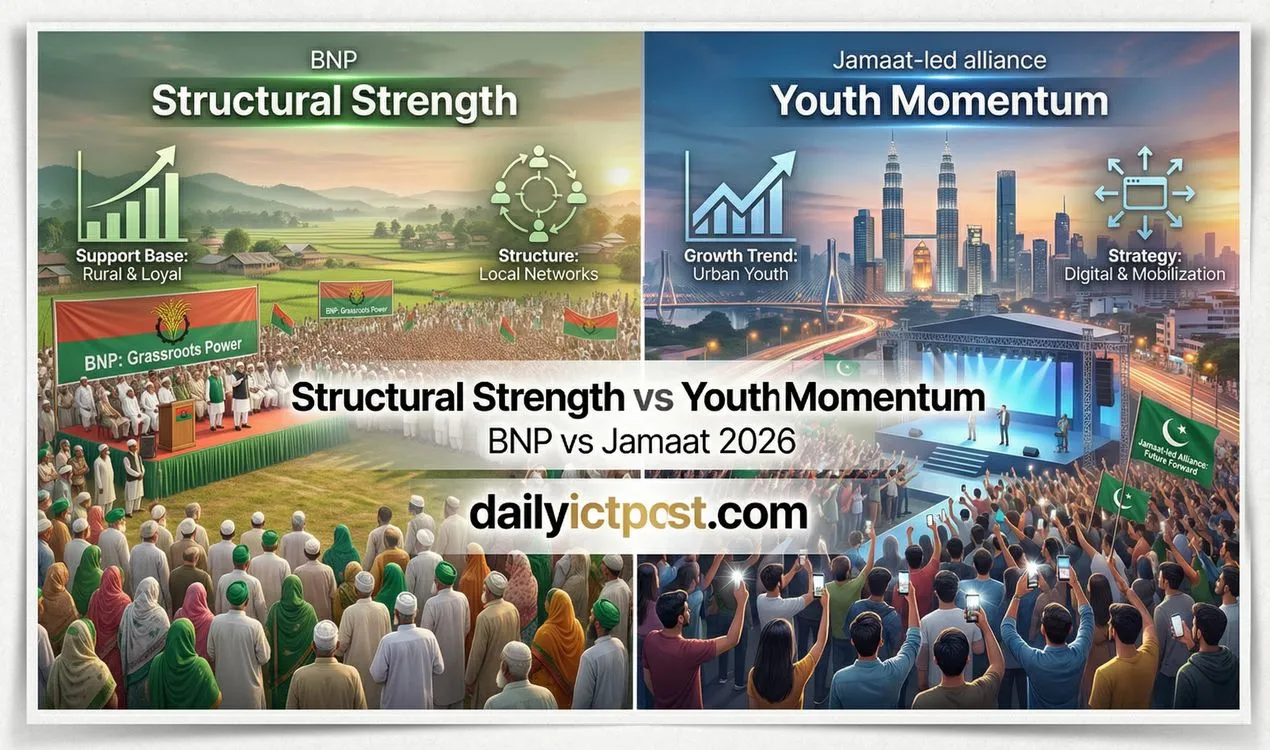
Rural vs Urban Impact: Ground mobilisation vs digital momentum
Core Question: Which structural advantage will translate into votes?
This analysis explores measurable trends, campaign positioning, and electoral variables shaping the 2026 parliamentary race.
To understand what’s at stake, we have to look at how we got here. This election is the culmination of the post-2024 uprising era. The interim government, led by Dr Muhammad Yunus, has spent the last year and a half trying to level the playing field and repair democratic institutions.
The atmosphere is electric but also tense. The “Anti-discrimination Student Movement” leaders haven’t just gone back to class; they’ve evolved into a political force, forming the National Citizen Party (NCP) and strategically aligning with Jamaat. On the other side, the BNP is running on a platform of experience, arguing that after a period of transition, the country needs a steady hand, not more experiments. It’s a classic clash between the promise of radical reform and the comfort of established stability.
The 13th parliamentary election is being conducted under the supervision of the Bangladesh Election Commission.
This election carries heavy weight. Voter turnout, alliance politics, and grassroots mobilisation will play critical roles.
In past elections, results were shaped by turnout and coalition strength. This time, observers believe public engagement is higher. When emotions run high, predictions become tricky. That’s why a structured Bangladesh election 2026 prediction must focus on measurable factors.
Politics is like a chessboard. One wrong move can change the entire game.
BNP’s Position in the 2026 Election
Let’s start with BNP.
The Bangladesh Nationalist Party (BNP) enters this election as the one on paper. Under the leadership of Tarique Rahman, who has been steering the ship since his return in late 2025, the party has revitalised its massive grassroots network.
The Bangladesh Nationalist Party has a long political history. Over the years, it built a strong grassroots network. District-level leadership remains active in many parts of the country.
The BNP’s biggest asset is its machinery. Go to any village in the country, and you will find a local BNP committee. This depth of organisation is crucial for “Get Out The Vote” efforts on election day. They are banking heavily on the traditional anti-Awami League vote bank, which has historically been a solid 30-35% of the electorate.
Grassroots Network
BNP has an established local structure. In many constituencies, party workers are deeply connected with communities.
Campaign Narrative:
Their message has been consistent and targeted. They are actively courting the “swing vote”—including disillusioned former Awami League supporters—by promising stability. Their slogan effectively communicates that running a state requires experience, positioning themselves as the “grown-ups in the room” compared to their newer rivals.
Youth Engagement
Young voters are a big factor in this Bangladesh election 2026 prediction. BNP has actively targeted first-time voters through digital platforms and rallies.
Regional Strongholds:
If historical trends hold, the BNP is poised to sweep the northern districts like Bogura and Rangpur. They also maintain a fortress-like grip on the Barisal division. For them to lose, there would need to be a catastrophic collapse in these key areas, which seems unlikely.
Opposition Unity Advantage
When opposition forces align, BNP often benefits from consolidated votes.
Challenges for BNP
However, no party moves without obstacles.
Internal coordination issues
Candidate selection disputes
Dependence on turnout levels
If turnout is high in urban areas, BNP may gain momentum. But if turnout drops, that advantage may shrink.
BNP vs Jamaat 2026
Jamaat’s Position in the 2026 Election
Now let’s talk about Jamaat.
If BNP is the analysts observe, Jamaat-e-Islami is the dark horse that has surprised everyone. Their comeback has been nothing short of historic. Once marginalised, they have rebranded effectively, largely thanks to a brilliant strategic move: the 11-party alliance.
Bangladesh Jamaat-e-Islami maintains a loyal and disciplined voter base. Their strength often lies in organisation rather than loud campaigning. Jamaat is also regarded as the Bangladesh election 2026 prediction trend.
The Gen Z Alliance:
Jamaat’s smartest play was aligning with the National Citizen Party (NCP). This bridged the gap between their traditional religious base and the modern, tech-savvy youth who led the 2024 uprising. These young voters are sceptical of the “old guard” politics of both the League and the BNP, and this alliance gives them a viable third option.
Core Support Base
Jamaat voters tend to be consistent. They show up. In close races, consistent voters matter more than large but inactive support.
Urban Appeal:
Contrary to popular belief, Jamaat is polling exceptionally well in urban centres like Dhaka and Chittagong. Their campaign focus on “Clean Politics” and anti-corruption measures is resonating with the educated middle class, who are tired of systemic graft.
Religious Influence Zones
In certain constituencies, ideological alignment gives Jamaat a clear base advantage.
Strategic Coalition:
By fielding candidates under a unified banner with smaller Islamic parties and student groups, they have consolidated the conservative vote while simultaneously peeling off reformist voters. They aren’t just running to be an opposition; they are running to govern.
Strategic Seat Targeting
Instead of spreading resources thin, Jamaat often focuses on winnable seats.
Challenges for Jamaat
Limited nationwide reach compared to BNP
Heavy dependence on alliance strategies
Urban competitive pressure
In this Bangladesh election 2026 prediction, Jamaat’s performance will depend on whether targeted constituencies hold strong.
Key Factors That May Decide the Winner
In an election this tight, the result will likely come down to a few specific variables. Now we move to the heart of this Bangladesh election 2026 prediction. Think of elections like cooking. Ingredients matter. But timing and heat decide the final taste.
Here are the deciding ingredients.
Voter Turnout Dynamics: The magic number is 70%. Traditionally, high turnout signals a wave for the opposition. But in this unique context, a massive turnout—especially among the 18-37 age demographic, which makes up nearly half the electorate—could trigger an upset favoring the Jamaat-NCP alliance. If the youth stay home, the BNP’s loyal base gives them the edge. High turnout often benefits larger opposition structures. Lower turnout favors disciplined voter bases. If youth participation spikes, BNP could gain. If traditional, loyal voters dominate, Jamaat could benefit.
Swing Voters: Swing voters are like floating boats. They shift based on mood, economic concerns, and campaign tone. Economic stability, local development issues, and leadership credibility will influence them.
The “Orphaned” Vote: The biggest wild card is the Awami League voter base. With their party banned, where do their votes go? It is unlikely they will vote for their arch-rivals, the BNP. This leaves them with two choices: stay home (which helps BNP) or strategically vote for the Jamaat alliance or independent candidates simply to block the BNP.
Rural vs Urban Split: Urban voters are more exposed to digital campaigns. Rural voters rely on direct outreach. This divide may shape the final numbers in the Bangladesh election 2026 prediction.
The Stability vs. Change Debate: The interim government brought a semblance of law and order that people appreciated. Voters are now weighing whether BNP’s “experience” guarantees that stability continues, or if the Jamaat alliance’s “reform” promises a better, albeit riskier, future.
Coalition Math: Alliances can flip the board instantly. If opposition unity remains strong, BNP may see numerical benefits. If fragmentation occurs, results could tighten.
Candidate Reputation: Local candidate image matters more than national speeches. In many seats, voters choose the person more than the party.
Scenario-Based Prediction
Predicting a Bangladesh election is always risky, but looking at the data, three distinct scenarios are emerging.
Scenario 1: The Stability Mandate (BNP Majority):
One possible outcome analysts consider is that rural voters, prioritising peace and familiarity, turn out in large numbers for the “Sheaf of Paddy.” In this scenario, the BNP secures a comfortable majority, a possible outcome, as the “safe” choice for a nation recovering from turmoil.
Scenario 2: The Youth Quake (Hung Parliament):
If the youth vote mobilises at unprecedented levels and the urban middle class rejects the traditional parties, we could see the Jamaat-led alliance securing 100+ seats. This would deny the BNP an absolute majority, forcing a coalition government or making independent candidates the kingmakers.
Scenario 3: The Urban-Rural Split:
A fascinating possibility is a split verdict—BNP sweeping the countryside while the Jamaat alliance dominates the major cities. This would create a strong, vocal opposition and a vibrant parliament, arguably the healthiest outcome for democracy.
Scenario 4: High Youth Turnout
If first-time voters participate heavily, BNP could see momentum in urban constituencies.
Scenario 5: Low Overall Turnout
Lower turnout may favour Jamaat’s disciplined base in targeted seats.
Scenario 6: Strong Opposition Coordination
If the alliance strategy remains unified, BNP may lead in more constituencies.
Scenario 7: Fragmented Opposition
If coordination weakens, vote splitting could benefit Jamaat in selected regions. Each scenario changes the equation.
That’s why any Bangladesh election 2026 prediction must stay flexible.
Data Comparison: BNP vs Jamaat 2026
To visualise where the parties stand, here is a breakdown of the Bangladesh election 2026 prediction. The following table compares structural strengths based on publicly observed campaign activity.
Factor
BNP
Jamaat-led Alliance
Organizational Reach
Very Strong (Nationwide presence)
Moderate (Strong in pockets)
Youth Engagement
Moderate
High (Boosted by NCP alliance)
Projected Vote Share
Estimated Support Range (Public discussion-based)
Estimated Support Range (Public discussion-based)
Core Base
Traditional Nationalists
Religious Conservatives & Reformists
Primary Advantage
Governance Experience
“Clean / New” Image
These figures reflect pre-election positioning and not official results.
Public Sentiment and Ground Reality
There is a fascinating disconnect between the digital world and the physical world right now.
On Social Media: If you look at Facebook or TikTok, you would think the election is already over. The Jamaat-NCP alliance dominates the narrative with slick, high-quality content and viral speeches from student leaders. They have completely captured the digital airwaves.
Political energy today is visible online.
Hashtags, live rallies, and youth engagement show increased excitement. But social media noise does not always equal votes.
A loud crowd online may not translate to polling stations.
Real strength is measured at the ballot box.
On the Ground: However, visit a tea stall in a rural village, and the conversation shifts. The older generation, the farmers, and the small traders are still talking about the BNP. Their sentiment is pragmatic: “We need a party that knows the ropes.” For them, the BNP represents a return to a familiar system, whereas the new alliance feels untested.
Conclusion
As we count down the final hours, the race for the Bangladesh election 2026 is tighter than anyone anticipated a year ago.
On paper, some analysts point to BNP’s nationwide structure as a structural advantage. However, the Jamaat-led alliance has fundamentally changed the game. They have captured the imagination of a generation and will likely emerge as a campaign momentum suggests, potentially denying the BNP the two-thirds majority they once expected.
Ultimately, the winner will be decided by one thing: will the electorate vote for the safety of the past, or the uncertainty of a new future? We will find out tomorrow. Here we have described the Bangladesh election 2026 prediction with a full analysis of the two political parties.
Author: Daily ICT News Reporter Updated: February 11, 2026
The dailyictpost.com team presents job recruitment notices, various government and private job question solutions, government post activities and technology-based information in simple and practical language. Along with this, we explain ICT, mobile, computer, apps, online income, digital tools, government services, national elections and cyber security-related issues in such a way that the reader can understand and learn.
We believe that learning technology is not difficult, if it is explained correctly. Therefore, we present complex topics like using new software, mobile settings or digital marketing step by step in such a language that it feels like someone is sitting next to you and explaining it in a simple way.
Our goal is only one - that the reader gets accurate information, learns with confidence and can use that knowledge in real life.